
The Future of Chess: How India and America Dominated the Top
The Rise and Fall of Chess Nations
The Rise and Fall of The Soviet School of Chess
For decades the Soviets dominated chess. The Soviet School of Chess started developing in the 1920s and dominated chess for decades. Nikolai Krylenko was a foundational figure and Mikhail Botvinnik was a pioneer figure in developing Soviet Chess.
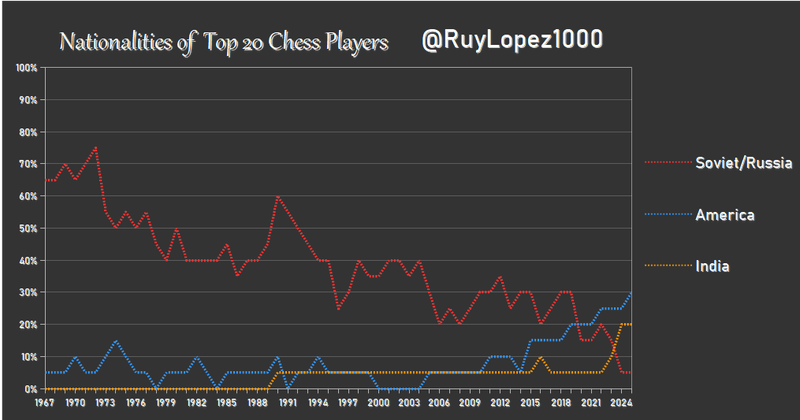
Data from 2700chess.com
This graph shows how the Soviet School of Chess declined over time. Vishy Anand carried India starting in 1990 for decades. Gukesh, Pragg, Erigaisi and Vidit were the products of the chess boom in India. US chess 'grew' through paying players from different countries to join.
1920s-1930s : Nikolai Krylenko
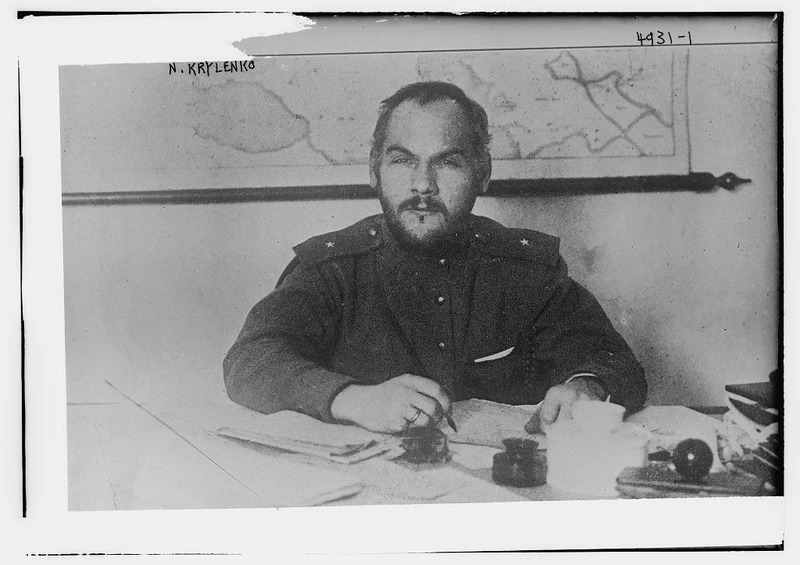
Nikolai Krylenko (1918) Credit: George Grantham Bain, Library of Congress
Nikolai Krylenko was the chief figure in the promotion of chess in the Soviet Union. He was a military commander during WW1 and later held a number of legal posts. He also was head of the Chess and Checkers section and edited the famous '64' chess magazine.
"N. V. Krylenko (a well-known Party and State official, a comrade-in-arm of Lenin) loved chess passionately. He played chess by post, took part in team events, spoke at chess meetings, wrote articles, edited chess publications and had a touching care for chess masters."
- Mikhail Botvinnik, Achieving The Aim (p.9-10)
If we had to choose one day as the official birth of the Soviet School of Chess it would be 10th November 1925. This was the inaugruation of the 1925 Moscow International Tournament.
The Soviets were not prominent in top level chess prior to this. Botvinnik recalls:
"Before this event [1925 Moscow International Tournament] only once had a Soviet Master played against the leading foreigners – I.Rabinovich won seventh prize in the Baden-Baden tournament. This was judged a great success, and when Rabinovich appeared in the new chess club in the spring of 1925 when the Leningrad Championship was in progress he was met by an ovation. However, this episodic success could not satisfy Krylenko."
- Mikhail Botvinnik, Achieving The Aim (p.10)
The tournament was organized by Nikolai Krylenko and featured the world's best players at the time such as Capablanca, Lasker, and Bogoljubov (winner of the tournament). The tournament was also packed with Soviet players eager to compete against these chess heroes. Krylenko created the tournament for Soviet players to play against the world's elite and to promote chess in the Soviet Union. The event caused a big stir with the venue being descended upon en masse by the general public. Mikhail Botvinnik described the atmosphere in his autobiography:
"The tournament provoked the first wave of enthusiasm for chess amongst Soviet people and, what is really important, amongst schoolchildren."
- Mikhail Botvinnik, Achieving The Aim (p.10-11)
" When I and several other players approached the House of the Unions, where the opening ceremony was to take place, there was a huge crowd on the street trying to get in. Working our way inside, we saw an even denser crowd, and it took a lot of effort to leave our coats in the cloakroom and get to the Blue Hall. Only a small fraction of the general public managed to get tickets and enter the hall. We feared for our foreign guests, but some people were sent out to greet them, and they started to enter the hall, one by one. The public in the packed hall stared at the foreigners with much interest and curiosity. Many people even stood up on their chairs."
- Alexander Ilyin-Zhenevsky (Soviet tournament participant), Diary
1930s-1990s : Mikhail Botvinnik
The engines of Soviet Chess were propelled by Mikhail Botvinnik. Botvinnik and Krylenko were friendly during the 1930s and Krylenko helped Botvinniks' chess career. Krylenko organized a match between Botvinnik and the great master Salo Flohr in 1933. Mikhail Botvinnik became the Sixth World Champion in 1948, during the round-robin tournament held after Alekhine's death to determine who would be the new champion. Botvinnik defeated Smylsov in a return match in 1958, and defeated Tal in 1961. After retiring in 1970, Botvinnik focused on training the next generation of chess players. Karpov, Kasparov and Kramnik were all pupils of Botvinnik, showing his monumental role in Soviet Chess.
 Botvinnik sitting on right, Karpov standing behind, Polugaevsky sitting on left center, Smyslov sitting in center. (1975). Credit: Reddit
Now too Soviet players have an interest in seeing a further growth of young talents. The competitions run by the Central Committee of the Komsomol help to popularise chess amongst schoolchildren and give us hope for a fresh reinforcement of the ranks of grandmasters. There are such events as the “White Rook” Tournament, to determine the strongest school chess team in the Soviet Union, and the “Pioneer Palace” Tournament where in the final grandmasters give clock simultaneouses against our best chess Pioneers. A striking confirmation of our hope is the successes of Garik Kasparov who is an excellent student in his school work, and plays well in tournaments and has a serious involvement in chess analysis.
- Mikhail Botvinnik, Achieving The Aim (p.200) (1981)
Why did the Soviet School of Chess Decline?
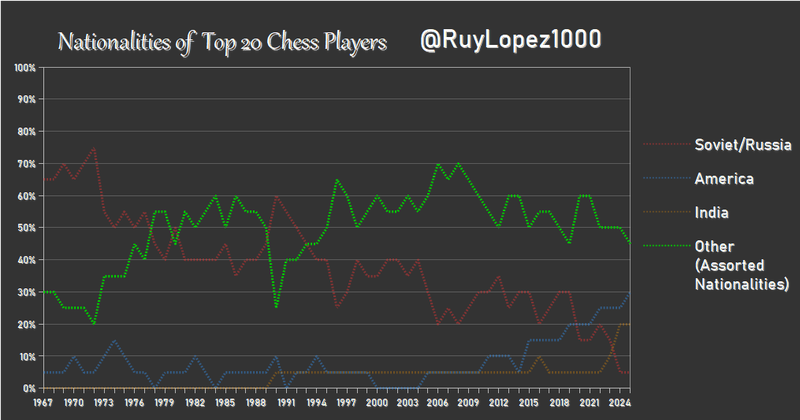
Data from 2700chess.com
The graph shows that the proportion of the other nationalities rose dramatically in the 1970s. Interestingly, it starts spiking after Bobby Fischer became champion. Perhaps it's because of the Fischer Boom (we can't know for certain). It could also be due to the Missing Soviet generation effect. In WW2 around 25 million Soviets were killed. This meant that the generation born in the 1920s would have been massacred, resulting in less people being born afterwards. In the 1960s the Soviets players were getting older and the new generation that was supposed to come afterwards was reduced in number due to the WW2 deaths, resulting in reduced population numbers for the next generation of chess players.
The Soviet decline was gradual and linear. This may indicate that it was simply due to other countries getting more players in top level chess (as the Others population increased dramatically). The dissolution of the Soviet Union in 1991 probably had only a minor effect as the proportion of Russian Players stayed around the same level in the graph. The Russian players outnumbered those from the former Soviet Republics.
India
Chess originated in India around 700 C.E. in the form of chaturanga - an ancient version of chess.
India was non-existent in top level chess for decades. British colonization exploited India, stealing its wealth. In 1947, after India gained independence, food shortages and famines ruled the land - a result of British exploitation which resulted in a lack of resources and no public utilities. No resources meant a lack of imported goods - India had to develop on its own with no help.
The country developed through the Five-Year Plans which focused on industrialization. The Green Revolution which revolutionized agriculture helped India gain independent means of producing crops, allowing exportation to the foreign markets to help gain wealth. The IT Boom in the 2000s further helped India recover. Better economic conditions means more chance of chess talents developing due to having more resources.
Vishy Anand rose to the top of chess in the 1990s. He became World Champion in 2000 after defeating Shirov in the final. He became World Champion again during the reunification tournament in 2007 and defended his title three more times (vs Kramnik 2008, Topalov 2010, Gelfand 2012). He is considered one of the greatest players of all time and a legend of the game.
But Anand also helped create a chess boom in India, inspiring other Indian talents through his dominance such as Gukesh, Pragg, Erigaisi and Vidit. Anand also helps develop Indian talent through WACA (Westbridge Anand Chess Academy).
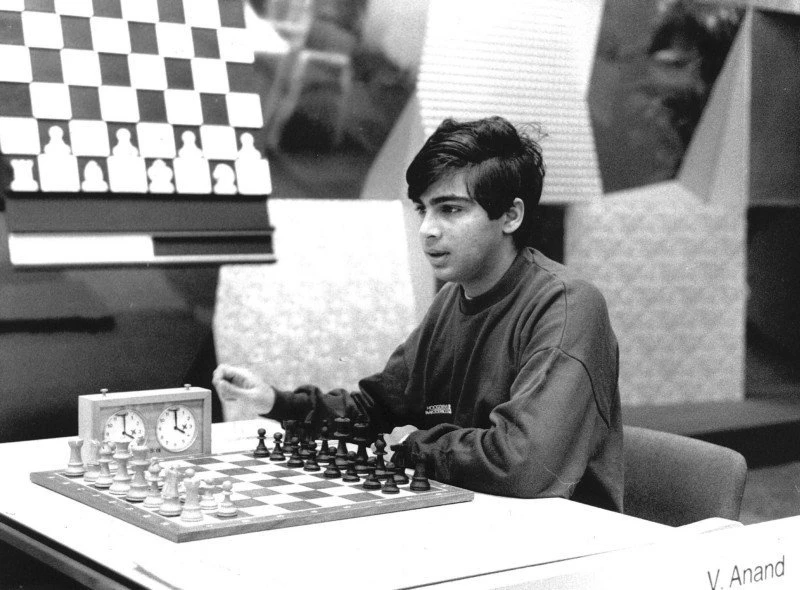
Vishy Anand at the Novi Sad Olympiad 1990, Credit: ChessBase India
The economic conditions are important to understand because it requires a lot of money to become a top level player. You have to be able to travel around the world to play tournaments. As India was economically impoverished at the beginning of its development, chess could not really develop as a sport. Vishy lit a spark which captured the nation, and the spark grew due to improved economic conditions as well as training from Vishy in the WACA academy.
"As always, you look for inspiration from the past. There were 2 things that immediately came to my mind, which I noticed when I was growing up. One was the Botvinnik Chess Academy. So, Botvinnik used to have an academy where the top soviet players, (now many of them are in their 70s, but they were juniors then) used to come to Botvinnik and he used to have these classes. Famously, Anatoly Karpov came to his academy and Botvinnik said “This boy has no talent” [laughs]. The second one was the American fellowship called the Samford fellowship, where a person called Mr. Samford had this money put away. He said that every year he wants to support American Juniors, because American Juniors are unable to play chess competitively due to the demands of university and a job. You have to invariably adapt any old idea to the new times; my idea was to combine these two. I’ll try to be like Botvinnik, setting some criteria to get people in, and also back them financially, allow them to dedicate themselves."
- Vishy Anand (2022), Interview with Sagar Shah
I can't really explain how much West Bridge and WACA have helped me, so I hope this partnership will go a long way and I'm really grateful that for the match I know that WACA and West Bridge are with me and things are taken care of."
- Gukesh (2024), Interview with Sagar Shah before winning the World Championship
America
How did the U.S. become prominent in the Top 20?
"so they are indeed buying nerds!"
- Magnus Carlsen tweet after Fabiano Caruana transferred from the Italian Federation to the U.S. Federation.
Nakamura, Caruana, So, Dominguez Perez, Aronian and Niemann are the Americans in the top 20.
Only Nakamura and Niemann have been with the U.S. Federation without being transferred.
- Caruana - Transferred 2015 (from Italy)
- So - Transferred 2014 (from Philippines)
- Dominguez Perez - Transferred 2018 (from Cuba)
- Aronian - Transferred 2021 (from Armenia)
Chess is unique in that player transfers for representing national federations are permitted.
This allowed US chess to stack the field by 'buying nerds'.
This explains the 'rise' of American chess.
Appendix
Rating List - June 1967
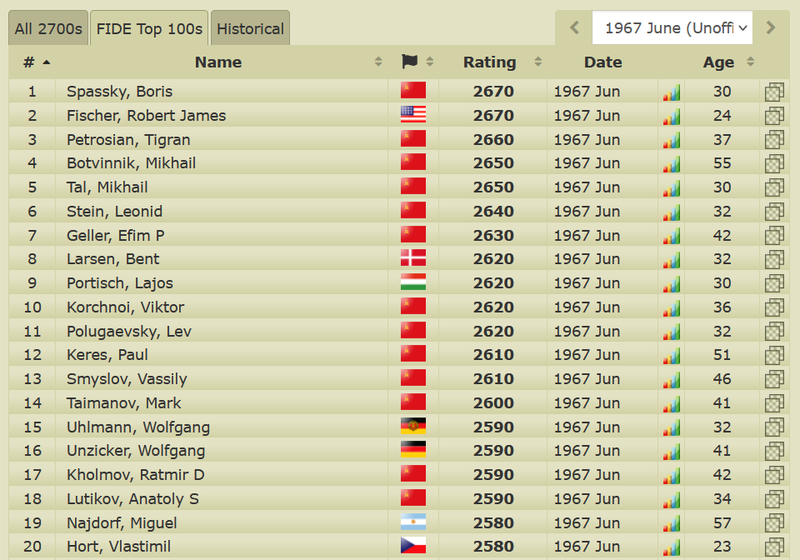
Data from 2700chess.com
Rating List - August 2025
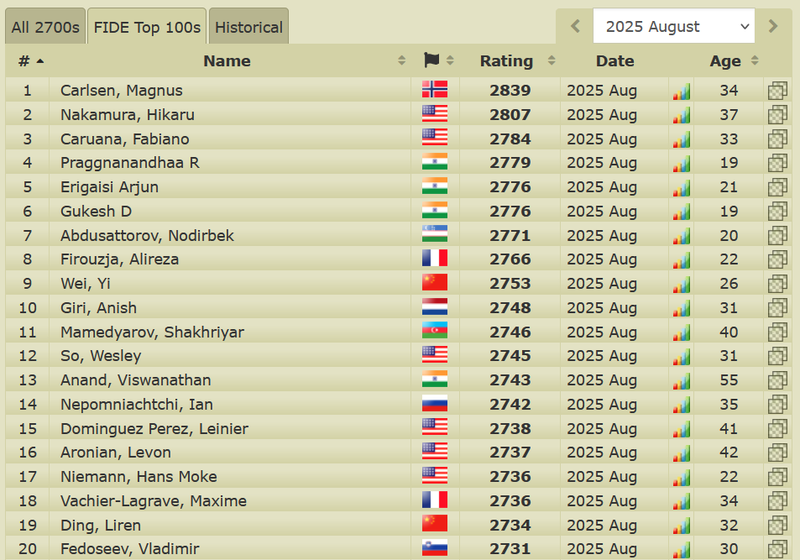
Data from 2700chess.com
Sources
- 2700chess.com Fide Top 100 History
- Mikhail Botvinnik - Achieving The Aim Autobiography (1981)
- Alexander Ilyin-Zhenevsky (Soviet tournament participant), Diary (Provided by User Spektrowski)
- India Economic Development
- FIDE Player Transfers
- Vishy Anand: Novi Sad Olympiad 1990
- Vishy Anand: Sagar Shah Interview
- Gukesh: Sagar Shah Interview
- Mikhail Botvinnik Photo
- Nikolai Krylenko Photo
- WW2 Stats

You may also like
 CM HGabor
How titled players lie to you
This post is a word of warning for the average club player. As the chess world is becoming increasin… RuyLopez1000
Bishop vs Knight: The Eternal Battle
Which piece is better: the knight or the bishop? (A question as old as time itself) IM datajunkie
25 lessons from 25 years of chess
Mistakes you can avoid and habits you can start with today GM Avetik_ChessMood
10 Things to Give Up to Enjoy Chess Fully
Discover how embracing a lighter mindset can help you enjoy chess again and achieve better results. ChessMonitor_Stats
Where do Grandmasters play Chess? - Lichess vs. Chess.com
This is the first large-scale analysis of Grandmaster activity across Chess.com and Lichess from 200… RuyLopez1000