
Karpov vs Kasparov: The Rivalry (Part 1: 1975-1985)
Explore One of the Greatest Rivalries in the History of Chess
Table of Contents
Prelude
First Meeting - 1975
1976-1983
1983 Candidates Matches
Karpov vs Kasparov 1984-85 World Chess Championship
The Termination
Prelude
24th April, 1975: Anatoly Karpov stood at the ceremony. FIDE President Max Euwe was next to him and said "I am happy to be present here on the occasion of this splendid event-coronation of the new World Champion".
Karpov felt disappointed that Fischer didn't play. Karpov beat Korchnoi in the finals, and was scheduled to play Fischer for the 1975 World Championship. But Fischer didn't wanna play. The deadline passed and then Karpov was declared champion on 15th April. One week later and now he's at the coronation ceremony. Karpov was thinking about the events that transpired.
You see, Fischer wanted an unlimited match with first to ten wins, where a 9-9 score means he retains the title. FIDE Congress in Nice only accepted 36 games, with no 9-9 draw clause, by a vote of 35-32. Karpov said that if it was accepted he [Karpov] would have no 'moral right' to play the match, meaning he would not play. The reason was because a 9-9 draw clause means that if the score was 8-8, Karpov would have to win 2 more games to become World Champion, due to the 9-9 clause. Karpov was relieved as he was worried that FIDE would accept Fischer's terms. But he was also disapointed that he wouldn't play Fischer.
 Anatoly Karpov: "I felt like the child who has been promised a wonderful toy and has it offered to him but then, at the last moment, it's taken away." Karpov on Karpov (1991).
Karpov's stream on consciousness: "I'm gonna prove my strength by playing ALL the tournaments.". And so he did, winning nine top level tournaments from 1975-77. Karpov was very positional, he would also strike immediately and play for a win if the opponent made a mistake. Karpov called himself an 'idler' when it came to studying chess.
Karpov was a popular guy in the Soviet Union. He defeated the Big Bad Korchnoi in the 1978 and 1981 World Championships. Korchnoi was treated as Voldemort and was simply refered to as 'the challenger' in the Soviet newspapers. Victor Korchnoi was officially an Enemy of the Soviet Union because he defected to the Netherlands in 1976.
Anyway, Karpov was a big star. He was the best player in the world. When he was asked about potential challengers he said: "I don't see anyone at the moment".
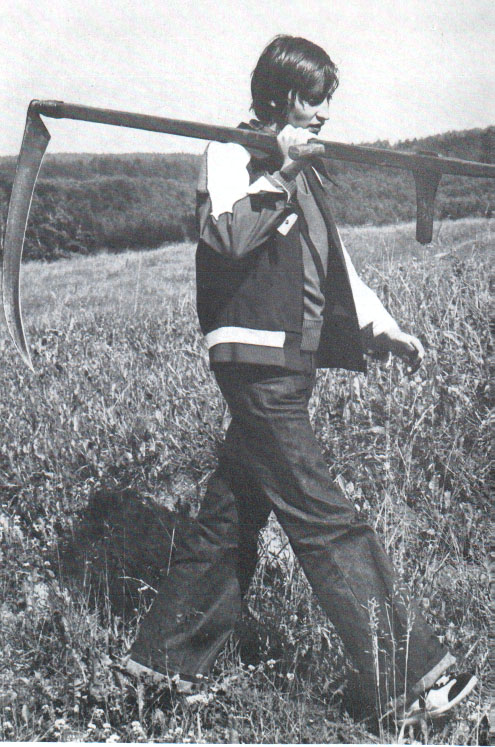 Karpov with a scythe. From Edward Winter Chess Notes
Kasparov rose in the early 80's and became Karpov's challenger. They went on to have 4 world championship matches. The two K's dominated the chess scene. There was also some beef between them.
First Meeting - 1975
Their first meeting was in 1975:
There was this event for juniors, when Kasparov was 12. Each junior team would play an opposing coach of another team in a simul. The coach that Kasparov's team [Baku] would face was Karpov, who was the coach of the Chelyabinsk team. Therefore, Kasparov and the other juniors on his team would play a simul against Karpov (who became World Champion earlier in the year one month before turning 24).
Kasparov's team were nervous cause they had to play World Champion Karpov. In the hotel foyer Kasparov said to other juniors on his team: "What are you afraid of? Karpov is the world champion, but even he can make a mistake".
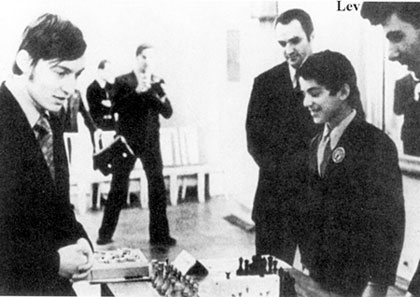 They met each other for the first time on 8th November, 1975.
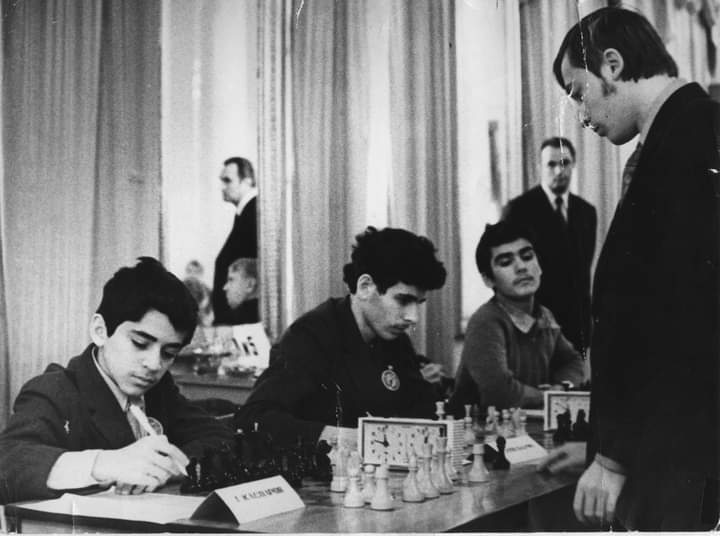 The opening moves of their simul game.
Karpov demolished the other juniors 5-0. His game against Kasparov was now the only one still going...
Garik Kasparov was very upset at losing to the world champion. "I had such a good position!" he lamented. The young Baku player was right. He held the initiative throughout almost the entire game, but he used it uncertainly, and in the end he made a fatal mistake.' I had the following dialogue with a journalist from the Baku sports newspaper: 'How do you explain your defeat at the hands of the world champion?' 'Perhaps by the fact that I remained one to one with him. Just imagine, sitting opposite you is the best player on the planet. And so I overlooked his combination.' 'And what lesson did you learn from this meeting?' 'You have to fight to the last, even if you are in a winning position.'
Garry Kasparov, Modern Chess Part Two Kasparov vs Karpov, 1975-1985, (2008) (p.17)
"Initially our relations were completely normal,' Karpov recalls. 'I remember a lively twelve-year-old boy, who played against me in a simul', then a youth with whom I played in the same team. He always showed me respect; at the same time he was independent, but invariably respectful. I saw that he was sizing me up, but only later did I realise that already then he was studying me. I only observed him, but already he was aiming at one thing - at the inevitable future rivalry with me. Already then his entire life was devoted only to this. But - I repeat - this in no way affected our relations. We weren't close - but also we did not clash. As is now clear - only because our interests did not cross."
Anatoly Karpov, quoted in Garry Kasparov, Modern Chess Part Two Kasparov vs Karpov, 1975-1985, (2008) (p.17)
1976-1983
Kasparov rose through the ranks, he won the USSR Junior Championship with 8.5/9. He got his first GM norm by winning the Banja Luka tournament with 11.5/15. In January 1980 Kasparov was rated 2595 at the age 16 (no. 16 in the world). Karpov was rated 2725 (no. 1 in the world).
In 1981, they played in the USSR Teams Tournament. There were 4 teams, Kasparov was part of the Youth team. There was also the First, Second and Veteran team. The Federation Officials said that Psaskis (USSR Champion, where Kasparov did not participate) or Yusupov should be Board One, even though Kasparov was far higher rated (2625, no. 7 in the world).
Kasparov says this is because Karpov did not want to play him on Board One. (Karpov was Board One for the First Team). Kasparov's team demanded that they decide by a vote, and they chose Kasparov 5-3. Karpov and Kasparov played in Round 3 and it was a draw. They faced each other again in the final Round 6, where Karpov was half a point behind Kasparov in the Board Performances. Karpov would have to win to get the best performance on Board One.
After this game the spectators stormed the stage, even though other games were still going on. Kasparov scored 4/6 having the best performance on Board One ahead of Karpov's 3.5/6.
They played again in the 1981 Moscow Tournament, where they had a 18 move draw in the last round. Karpov won the tournament with 9/13, with Kasparov, Smylsov and Polugaevsky tied for second with 7.5/13.
In 1982, Kasparov was invited to tournaments in London, Turin, and Bugojno. Kasparov and his trainers chose to play in Bugojno, Yugoslavia.
"However, Nikolai Krogius, the head of the Sports Committee Chess Administration, had 'his' view on things: he offered me a run-of-the-mill tournament in Dortmund (9th category, I think). This was degrading for a player of my standard, and I could not understand it. After all, I had a far higher international rating than those who were freely granted permission to take part in the top tournaments. When I asked Krogius what was the meaning of all this, he replied with disarming frankness and without any particular sign of that personal enmity towards me, which was to appear later: 'We have a world champion, and we don't need another one.'"
Garry Kasparov, Modern Chess Part Two Kasparov vs Karpov, 1975-1985, (2008) (p.34)
"At that time the leader of Azerbaijan was Geidar Aliev, a Candidate Member of the Politburo and the future President of the independent state. In January 1982 he warmly congratulated me on my victory in the USSR Championship. In March I was invited to speak at a Congress of the Azerbaijan Komsomol. I don't know who invited them, but Sevastyanov and Viktor Ivonin, deputy chairman of the USSR Sports Committee with a special interest in chess, unexpectedly arrived at the Congress. On seeing them I decided to appeal directly to the head of the Chess Federation and the Sports Com mittee and also to Aliev. The result exceeded all expectations: I was given per mission to play in Bugojno! Later in diffi cult situations I again had to appeal to Aliev for help, and he did everything possible to help me realise my lawful rights, earned at the chess board. The May super-tournament in Bugojno assembled a whole constellation of big names (but Karpov wasn't there: the two times winner of these tournaments preferred to play in London and Turin)."
Garry Kasparov, Modern Chess Part Two Kasparov vs Karpov, 1975-1985, (2008) (p.34)
1983 Candidates Matches
In 1982, Kasparov qualified to the Candidates Matches through the Moscow Interzonal with 10/13, winning four games in a row at the end. He beat Beliavsky in the first match 6-3. Next he was paired with Korchnoi. Smyslov was paired against Ribli. For the match Kasparov and Korchnoi had to give their preferred places to play. Korchnoi gave Rotterdam. Kasparov was told by the Soviet Sports Committee to put Las Palmas first, and then Rotterdam as second choice for political reasons. Even though Kasparov wanted to play in Rotterdam. Apparently this was cause Las Palmas was pro-Soviet and choosing Rotterdam first would be conceding to the Big Bad Korchnoi.
FIDE President Campomanes then said the match would take place in Pasadena even though neither Kasparov nor Korchnoi had selected that place. Campomanes said it was because Pasadena was offering the biggest prize fund as well as a 40,000 USD bonus towards developing chess in the Third World. Campomanes also chose Abu Dhabi for the Smyslov-Ribi match. The Soviets also didn't want Smyslov to play in Abu Dhabi due to the hot weather (Smyslov was 62). The Soviets said that 'safety of Kasparov and the members of his delegation could not be guaranteed, since Pasadena was closed to Soviet diplomats'. Then there was a meeting with Soviet Federation officials and Campomanes to discuss the situation with Kasparov, Smyslov and Karpov present. Kasparov was not allowed to play in Pasadena with Kochnoi.
Karpov then invited Kasparov to his place for a chat.
"That was when Kasparov and I came closer together. In those days he came to my place several times. And I found I could have a reasonable discussion with him, as he not only spoke himself, but was also capable of listening and even accepting someone else's idea - if there was a rational basis to it. He realised that for success in the matter my position alone was not enough, but that also required were my clearly expressed interest, energy and fundamental belief, and he went to every length to support my fighting mood.
But at the same time he was playing a game behind the scenes. Gramov, the Chairman of the Sports Committee, suddenly suggested that I should make a statement that I would not play the winner of the Korchnoi Ribli match. To which, naturally, I replied: it was not I who caused the matches to collapse - it was you who did this, and it is not for you to decide for me which match I should play, and which not... The pressure on me was terrible. It stands to reason that I did not go along with this dirty game, but, making use of my good relations with Campomanes, I did everything possible to resolve the conflict and save the matches."
Anatoly Karpov, quoted in Garry Kasparov, Modern Chess Part Two Kasparov vs Karpov, 1975-1985, (2008) (p.51)
It was during those days of crisis that I spoke with Karpov for the first time. After the ending of the discussions in the Sports Committee the world champion suggested that we should discuss the situation in private. The conversation, which took place in his home on 15 July, was psychologically very difficult for me. Karpov insistently tried to convince me that the most important thing now was not to allow the break up of FIDE, or, as he expressed it, not to be mated in one move. Therefore, he went on, the staging of the Smyslov-Ribli match should not be prevented, and for the match in Pasadena it was necessary to begin a joint campaign. At the same time he advised me to appeal to Geidar Aliev, at that time already a member of Politburo, and for his part he promised to arrange a meeting with Mikhail Zimyanin, a Secretary of the Communist Party Central Committee.
I found it hard to understand all the complexities of the behind-the-scenes struggle being conducted around the match, but at that moment I instinctively sensed the danger. After all, I already knew that in the Central Committee and the KGB they considered the match in Pasadena to be a politically incorrect step. Already then the decision to boycott the 1984 Olympiad in Los Angeles had probably been taken, and Karpov knew about this. This was why it was so important to separate the matches in Abu Dhabi and Pasadena. Karpov's promise to find in the future some other way of including me in the Candidates cycle, if the match with Korchnoi nevertheless did not take place, merely strengthened my suspicions. From that point on I was in no doubt that the only way of continuing my battle for the world title was to ensure that both semi-final matches started at the same time."
Garry Kasparov, Modern Chess Part Two Kasparov vs Karpov, 1975-1985, (2008) (p.45)
Kasparov went to his mother and said "Look... That's it!... I was getting ready to play the World Championship, and I got thrown out of the cycle!". Kasparov's mother said that he should call up Aliev (Politburo member who supported Kasparov). Heydar Aliev was the First Secretary of the Communist Party of Azerbaijan in Azerbaijan SSR (Soviet Socialist Republic). Aliev was also a Politburo (Soviet leadership) member. Kasaprov was also born in Baku, Azerbaijan. Aliev was a big supporter of Kasparov. So Kasparov did and explained the situation.
Kasaprov says that Stukalin (Communist Party Central Committee) said to him : "You are still young, you can afford to wait for three years" as a reaction to Kasparov asking why he was the only one who couldn't play.
As a result, Korchnoi won the match in Pasadena, showing up to the table alone at the starting time. Kasparov was forfeited because he wasn't allowed to go.
Kasaprov was then invited to a super-tournament in Niksic. The organizers invited Kasparov as a shown of support. At the tournament, the participants all signed a petition supporting Kasparov.
Kasparov says that Aliev's initiative turned the tables as well as the fact that the Smyslov match was falling apart. Kasparov: 'Yes, one disqualified Candidate might somehow be justified, but two - that was going too far!'. He says that after Aliev's orders the Sport Committee changed it's position on the Smyslov match taking place, now opposing its staging. The Abu Dhabi match offer was withdrawn by the organizers because they saw that the Soviets did not support the match. Kasparov says that Campomanes was trying to make the Smyslov match happen in order to isolate him [Kasparov] and halt his chance to play in the Candidates.
The Soviet Chess Federation ended up having to pay FIDE compensation for organizing costs incurred by the disruption of the match, compensation for Korchnoi and moral damage to FIDE. They also had to agree not to boycott Korchnoi in competitons. Korchnoi agreed to restart his match against Kasparov.
Kasparov said that all this was a plan to prevent him from playing Karpov which Karpov and his supporters engineered with Campomanes. By telling Kasparov to select Rotterdam second, and then having Campomanes to select a place that the Soviets would never agree to they stopped Kasparov playing in the candidates, and stopped him from facing Karpov potentially. Karpov denies this:
"Of course, I was taking the "risk" that my efforts would lead to me having to face Kasparov, but it is no accident that I put the word "risk" in inverted commas. The Kasparov of that time was not yet a serious rival to me. I saw all his weaknesses and I was in no doubt that at the chess board I would deal with him without much trouble. This match was even in my interests: the sooner we met, the more crushing would be the score (and the course of the first match showed that this was right). I would have given this impressionable and impulsive young man a severe inferiority complex, and it would have taken some time for him to free himself of it.
Wouldn't you agree that this is a simple argument against all Kasparov's fabrications about my villainous plans and deeds? ... I even flew to the Philippines: we all thought that in the interests of the matter it would do no harm to exploit my good relations with Campomanes. And this reckoning proved justified."
Anatoly Karpov, quoted in Garry Kasparov, Modern Chess Part Two Kasparov vs Karpov, 1975-1985, (2008) (p.52)
Kasparov defeated Korchnoi 7-4, and went on to defeat Smyslov 8½-4½ in the Candidates Final, qualifying to play Karpov for the World Championship Match. Karpov and Kasparov played in the USSR vs the World match in London in June 1984, on board 1 and 2 respectively. The USSR team won 21-19.
Karpov vs Kasparov 1984-85 World Chess Championship
Kasparov qualified to play Karpov for the World Championship. Kasparov was by now ranked no. 1 in the world with a rating of 2715, Karpov was no. 2 with a rating of 2705. It took place in Moscow, starting on September 10th, 1984. Svetozar Gligoric was the arbiter for the match. For the opening ceremony, they drew the color of the first game through Russian dolls instead of envelopes. Karpov got the White pieces for the first game. The match format was first to 6 wins in an unlimited match. The match was played in the prestigious Hall of Columns in the House of Unions.
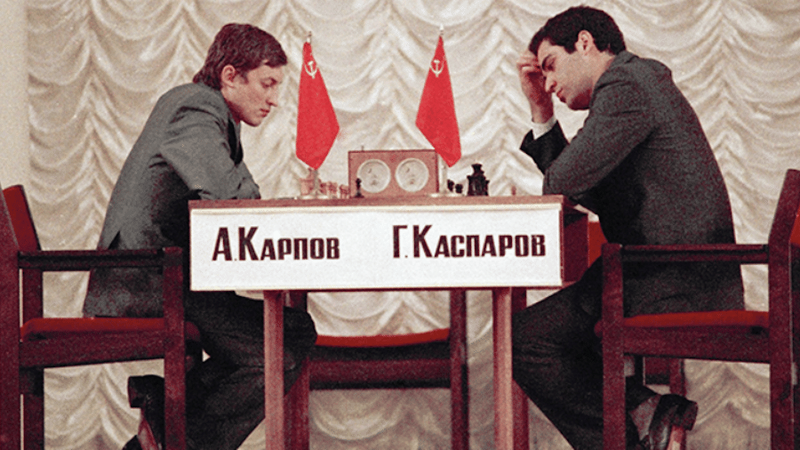
Game 1 and 2 were draws. Karpov won Game 3. He explains the game in this video:
https://www.youtube.com/watch?v=76WqGDm613A
After two draws, Karpov won Game 6. Karpov was now 2-0.
Karpov won Game 7 as well, making two back to back victories (3-0).
After a draw in Game 8, Karpov yet again won in Game 9 in a classic endgame.
Now the score was 4-0 in Karpov's favour, a brutal stomping.
Harry Golombek, writing in The Times Magazine, claimed with no evidence that Kasparov was being ordered to lose to Karpov, and that's why he was down so much in the match: 'Perhaps Kasparov has been warned not to play well and has been given to understand that the consequences for him and his family would be disastrous if he did.'. Kasparov himself later pointed out that this was false.
Now there followed a series of 17 draws. Kasparov was trying to hang on. According to Kasparov, Karpov was aiming for a 6-0 finish to get a 'Fischer score' (Fischer beat Taimanov and Larsen 6-0 in the 1971 Candidates Matches). Kasparov says that Karpov did not want to risk a loss by going all out. The match had now gone on for 2 and a half months at this point.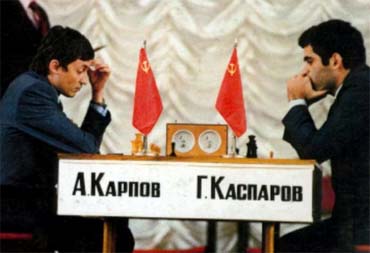
When Karpov was being driven to the adjourned session for the 27th game, his car skidded around three times on the icy road. He went on to win the game.
Now the score was 5-0, one more win and Karpov would win the match.
 Credit: Rodrigo Fernandez, Chess Life, April 1985
After 4 draws, Kasparov defeated Karpov for the first time in his life in Game 32:
"The score became 5-1 (with 26 draws) in Karpov's favour. We were jubilant: by scoring a consolation goal, I had avoided a complete rout! The situation in the match changed radically: the loss in the 32nd game dispelled Karpov's dreams of repeating Fischer's feats. In order to calm down somewhat and take stock of the new situation, I took a time-out."
Garry Kasparov, Modern Chess Part Two Kasparov vs Karpov, 1975-1985, (2008) (p.182)
Q: You had great chances of winning the first match against Garry Kasparov in 1984, since you were leading 5:0. If you had made a clean sweep, would Kasparov have been able to make a comeback and ever become World Champion?
Karpov: "No! 100%! For him it would have been a terrible blow, which Kasparov, as an emotional man, wouldn’t have been able to handle. As it was he only barely managed to recover. Well, and he got 48 free lessons from me."
Anatoly Karpov, Interview, (2021)
Now there followed a series of 14 draws. The match had been going on for nearly five months. FIDE general secretary Lim Kok Ann summed up the mood:
"In November the WCM had recieved bad publicity because of the draws that followed one another. One international chess magazine used the headline "World (Yawn) Championship" just before the score reached 5-0; another published a cartoon showing two skeletons at the chess board. In Moscow and in Thessaloniki during the FIDE Congress, many were asking openly "when is all this (the match) going to end?" Kasparov won his first game on December 13, after which the match yielded a new series of draws, 14 draws in succesion till 28 January. The organizers were having great diffculties obtaining a new playing hall for an indefinite period because the implication of the "unlimited games" rule had just been realized. Both players objected strongly to a change of playing hall though the organizers' lease on the Hall of Columns had long expired. So, as the new year began the President tried to find a way acceptable to all parties for ending the match. His proposal was (1) to limit the match to eight more games. (2) If no decision was reached within these eight games the match would be terminated and a new match over 24 games started in September 1985 with the score at 0-0."
FIDE President’s Circular Letter No. 3 1985/86, 25 February 1986, ‘Review of Press Reports’ by Lim Kok Ann. In Edward Winter Chess Notes.
On January 30th, Game 47 was played. Kasparov won his second game in the match. Now the score was 5-2 in Karpov's favour.
On 31st January, the match was moved from the Hall of Columns to the Sport Hotel. Game 48 was postponed for February 4th due to the venue being changed. On February 1st, Campomanes wanted to have a meeting with Karpov and Kasparov. Mamedov acted as Kasparov's representative. Mamedov conveyed that Kasparov wanted to continue the match. The next day, Kinzel took over the negotiations as Campomanes flew to Dubai to organize details about the Olympiad. Campomanes had proposed 8 more games where if there was no result then Karpov would remain champion and a new match would start in September with a score of 0-0.
Kasparov objected to this suggestion saying "If the rules are being changed anyway, why then do we need to play these extra games?", he later called this comment a 'tactical mistake'. Kinzel stated that Kasaprov would only agree to terminating the match if a new match would start at 0-0. Karpov rejected this when propositioned with this suggestion from Kinzel, stating that it should start at 5-2 which was the current score.
Kasaprov states: "I would have been ready for an end to the match right at the start of the negotiations – if they had accepted me as an equal partner and had offered me acceptable terms". Kasparov reflects: "I couldn't agree to this proposal - its absurdity was obvious. For me to clinch the match I would have to win every other game (and this in a situation when in the previous 47 games there had been only seven wins). And at the same time there would come a point when Karpov could take risks without any fear at all of losing! "
According to FIDE General Secretary Lim Kok Ann, Kasparov's position gave Campomanes the idea of terminating the match immediately. "Not to intervene in the match would have been the easiest way out but allowing the match to continue indefinitely would have placed the World Chess Federation in the position of being responsible for the consequences of a breakdown on the part of Karpov or Kasparov."
"No one has given a convincing answer to these very practical questions : if Campomanes had allowed the match to continue, for how many more weeks should reservations be made for the tournament hall and hotels (the organizing committee had to provide first class board and lodging for over 20 people)."
On January 4th, Gligoric gave Kasparov a proposal from Karpov. The proposal was that Kasparov acknowledges that he has been defeated in the match. And then a new match will take place at 0-0. If Kasparov wins by at least 4 points he will become World Champion. But if he wins by only 3 points or less, then he will only be World Champion till 1st January 1986 'since he will not have demonstrated his superiority over Karpov over the two matches.' Then then title would switch to Karpov, with Kasparov playing in the Candidates matches. Kasparov rejected this and asked Kinzel 'didn't he think these conditions were an insult to me?'. Kasparov says that Kinzel hinted that 'the next match might be held abroad, where the prize money would be much higher' and that he replied that 'money could not compensate for injustice.'
Karpov took a time out on January 6th. Kasparov wrote to Demichev (chairman of the organizing committee) saying that the delays were being used to give Karpov time to recover. Kasparov says in a phone call with Demichev, he said that they were concerned about the health of the players and 'added that the game should be played honestly and that it was wrong 'to hit a man when he is down', meaning Karpov'.
On February 8th, Game 48 took place. According to Karpov, former Komsomol Central Committee First Secretary Evgeny Mikhailovich Tyazhelnikov accidently came to a briefing room for the public before the game and saw that the audience members were being told 'when Kasparov is thinking, keep silence, and when Karpov is thinking, cough away.'
Tofik Dadashev was Kasparov's psychological assistant. Karpov says he saw Dadashev staring at him in the audience during Game 48, trying to hypnotise him. He wondered why this man was so intently statring at him and 'knew that it wasn't out of simple curiosity'. Later when he met Dadashev he knew it was him.
Kasparov won, now having two back to back victories and bringing the score to 5-3 in Karpov's favour.
On February 9th, Kinzel needed to call Campomanes to consult on the negotiations. He needed as translator so he had Gligoric translate and relay his message to Campomanes, to ask for a meeting in Luscerne. Gligoric did so. Campomanes decided to handle the situation himself by going to Moscow.
Kasaprov took a time out on 11th February 'because I needed it ... after all the excitement, I needed time to draw breath'. Campomanes arrived on the same day. On the night of 11-12th February, Campomanes gave Mamedov a proposal to limit the match to 60 games.
On February 13th, Chairman Sevastyanov of the USSR Chess Federation sent a message to Campomanes suggesting to pause the match for 3 months and then resume play (score would still be 5-3 to Karpov) on the basis of the players' health. Campomanes rejected this proposal. Campomanes called another time out.
Kasparov called Demichev after Campomanes called this time out and says that Demichev 'told me candidly that the reason for the break was Karpov's unsatisfactory state of health (although he still had one time-out which he could have claimed), of which he, Demichev, had been informed that morning by Gramov'. Kasparov also says that Demichev talked about sporting ethics, the exhausion of the players, and needed to end the match in a amicable way. Gramov then called Kasparov and said that he take up his issues with Campomanes as the responsibility for the match was with FIDE. Kasparov then said that no-one asked Campomanes to call for a time out.
On February 14th, Campomanes and Gligoric met with Kasparov. Kasparov said that either Karpov resigns the match if he can't continue due to his health, or else the match should continue. Campomanes called a time out again for the next day to announce his decision.
The Termination
The Termination is a famous day in chess. It's called the Termination because FIDE President Campomanes terminated the match. Karpov was leading 5-3 at this point, after Kasparov came back from 5-0 with three wins (and two wins in a row in the last two games (47 and 48)). They were playing in Moscow City Hall for 5 months at this point. Campomanes cited the players' health as a reason for stopping the match.
Kasparov called it 'a day of shame in the history of chess'. He also called Campomanes a dictator.
Kasparov claimed that the match being terminated was because Karpov pulled the strings because he thought he was gonna lose. He claimed that Karpov used his influence to cancel the match.
Kasparov claims that Karpov was psychologically demolished at the end of the match and could not go on playing.
"The people around him [Karpov] attributed my late victories to the fact that he was so exhausted, but Karpov knew better. He knew it was my chess that was beating him."
Garry Kasparov, Child of Change, (1987) (p.143). In Edward Winter, Child of Change
"It would appear that after the 48th game Karpov was completely devastated and not ready to continue the match. Both the result and the course of the game itself put the champion and his circle in a very pessimistic mood. It was not so much a question of his physical fatigue (in my opinion, Karpov was in principle still capable), but rather the psychological disaster. The score had now become 5-3 (it was once 5-0!), but the main thing was that Karpov had completely lost the match initiative. "
"Later I became convinced that the decision to stop the match was carried out not so much because of any risk to the champion's health, but rather in view of his psychological exhaustion, confusion, and fear of continuing. No other way of retaining his title was now apparent: had Karpov also lost a fourth game, the only way to complete the match would have been in accordance with the regulations. And the powers which at that time controlled Soviet sport, including chess, decided not to take that risk."
Garry Kasparov, Modern Chess Part Two Kasparov vs Karpov, 1975-1985, (2008) (p.245)
Karpov believed that Aliev had interfered to cancel the match as he was leading.
"Of course - that's why Yakovlev and Aliev interfered. They demanded to stop the match when I led 5-3, thus stealing two points from me. No matter how bad I felt, Kasparov also wasn't in his ideal form, and he was hanging on in there for 21 games, from game 27 to 48. One mistake, and the match ends! Yes, Kasparov did win two games in a row, but he still had to win three more games, and I needed just one. So, they stole more than two points from me: they also took away the advantage of one good move or one opponent's mistake."
Anatoly Karpov, Interview, (2007)
"My great blunder was that I agreed to hold the match with Kasparov in the Soviet Union. It’s unlikely that anywhere else would have seen such a disregard for the rules and responsibilities on the part of the organisers. When I drew his attention to it, Gramov, the Minister of Sport and a total idiot, exclaimed: “What protests? I don’t even want to hear about them! You’re Soviet people. Whatever we say, that’s what you do!” All that led to a completely unforgivable twisting of the match. I think it was on the initiative of Heydar Aliyev, who was then the First Deputy Chairman of the Council of Ministers. Campomanes resisted to the end, realising what the reaction of the world would be."
Anatoly Karpov, Interview, (2021)
"On one side he [Kasparov] says during Breznev's time and immediately after he was in a very difficult situation, but at the same time he writes that Aliev, who is displaced now, was his close and very big supporter since he was seventeen years old. But Aliev was the main person in our government and the plitiburo who was in charge of sports and culture, so nobody could go higher, because he could solve all the questions, all the problems himself. He was a very senior man in this area and it's hard to believe that the Sport Commitee, which was under Aliev, would stop the match just because I wanted it, or somebody wanted it. So this is just ridiculous."
Anatoly Karpov, David Redhill Interview, (1988)
On 15th February Campomanes held the press conference to announce the fate of the match. Before the press conference started, Karpov told Campomanes that he wanted to continue the match on Monday: 'Campomanes: Mr Karpov was ready 25 minutes ago and told me to please not play today 'cause Mr Kasparov and he are psychologically unprepared for today 'cause of all this brouhaha. He asked to start playing Monday, to the better or bitter end'.
Kasparov says that the head of his delegation was told not to let him come to the press conference in case he caused a scene. Kasparov did show up, choosing to not sit at the front of the audience to show that he was not a part of the official proceedings. Campomanes then announced that the match would be terminated due to concerns of the health of the players.
Campomanes: "Whereas in accordance with FIDE statutes the President is empowered to make decisions between congresses; whereas under-the match regulations the President is personally and officially responsible for the entire match and is further empowered to make the final decision on all questions affecting the match as a whole— I therefore declare that the match is ended without decision. There will be a new match which will start from scratch — the score at 0-0 — on September 1, 1985. The two players consent. The next FIDE congress in August shall determine further necessary match provisions. The winner of that match will be the world champion for the period of 1985-1986. Thank you."
Campomanes: "This match has beat all the records — the greatest number of games, the greatest number of draws, a duration of more than five months. It has exhausted the physical, if not the psychological, resources of the participants and all those connected with the match — however distant that connection might be. I, for one, have not been fully able to perform my functions and fulfill my other duties as President of FIDE because it has hovered over all my activities."
Press Conference Transcript from Garry Kasparov, Modern Chess Part Two Kasparov vs Karpov, 1975-1985, (2008), (p.253)
Then Karpov showed up and Campomanes invited him over. Karpov said that he disagreed with terminating the match. Campomanes then said: "(smiling): Gentlemen, now you know what I told you earlier was true. I have a verification right here in the friend - in the person - of the world champion. I have mentioned this to you and now Mr Kasparov will know that I now told you the truth." Then someone in the audience said "Let's hear what Kasparov has to say". And Karpov said "I think we should invite Kasparov here (with a hand gesture)". So Kasparov walked to the press conference table.
Karpov: "And I consider that we can and we ought to continue the match - and the proposal to end it, and to start from scratch, I do not agree with such a decision (applause from audience). I consider that on Monday we should start, or rather resume and continue our match. I think Kasparov will second my proposal and there should be no problem at all (applause)."
"Kasparov: I want to ask Mr President one question - what all that show is for? Mr President, I shall explain here what I mean. You said you have come here 25 minutes after your talk with the Champion and that he was against breaking the match. You knew my point of view too - that I was also objecting to ending or suspending the match with technical time-outs. Nevertheless you came here and declared your point of view that, despite all those objections, the game is ended. What do we need it for? Twenty-five minutes ago you were speaking with Karpov and now suddenly such a divergence. Will you tell us, or at least me?"
"Kasparov: Give me the floor. I want to make known my declaration. The President's profession is to speak. My trade is to play chess. That is why I am not going to compete with him on the podium - first. Second, I want to say what I think. I don't intend to demand a continuation because I'm convinced I shall win very easily be cause the Champion feels unwell. He's here, he can proceed, we can see it. But for the first time in five months I have certain chances, let's say about 25% or 30%, and now they are trying to deprive me of those chances by the numerous delays - and let those who delayed the match be responsible. The match should continue - I have been speaking about it two weeks ago - without time-outs, without intervals, but it is being prolonged. With each delay his chances are growing while mine are diminishing (applause)."
 Campomanes and Karpov at the press conference. Credit: Rodrigo Fernandez, Chess Life May 1985
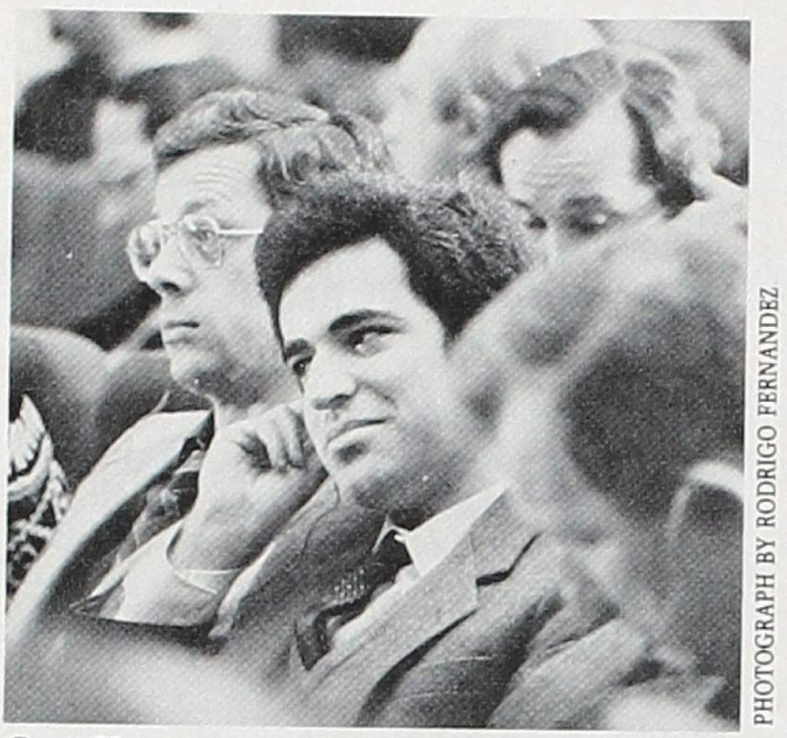 Kasparov watching the press conference in the audience. Credit: Rodrigo Fernandez, Chess Life, May 1985
Afterwards there was a big meeting with Karpov and Kasparov and other officials. Campomanes announced at the end of the press conference that the it would be a 10 minute break. The meeting lasted 1 hour and 38 minutes, leaving all the journalists waiting behind in the press room. The Soviet Federation officials tried to persuade Karpov and Kasparov to sign a document agreeing to Campomanes decision. Neither Karpov nor Kasparov wanted to sign. Eventually Karpov signed 'only after Sevastyanov slapped him on the shoulder and said: 'Come on, Tolya, sign it. It's a good piece of paper'. Karpov wanted to ensure that he gets a right to a return match, as he was leading this match. Kasparov refused to sign the paper. Karpov said he signed on the assumption that Kasparov would sign.
 Kasparov talking to the press after the meeting. Credit: Rodrigo Fernandez, Chess Life, May 1985
Campomanes: "The world champion accepts the decision of the President and the challenger abides by the decision of the President. In the course of the meeting I have appreciated the thinking of the world champion who feels very strongly that he deserves, or has the right to, a return match after the new match. I have appreciated likewise the strong wish of the challenger that the provisions for the next match be ascertained fully since he felt that leaving it hanging in congress or for the decision of the FIDE Congress in September, in August, is not the most suitable arrangement for him. "
Karpov says he agreed to this at the time but then realized it was a big mistake and tried to cancel. But that Kasparov's team was given the offer and accepted so Karpov couldn't change the decision.
Karpov: "Those days left a heavy residue in my heart. And not only because victory was taken away from me without a fight. The main thing was that I was denied the opportunity to immediately explain the truth to my people ... I was treated like a child ... I wrote an open letter with a protest and a demand that the match should be immediately restarted, and I decided to publish it through the Reuters agency (around the world) and through TASS (around the USSR)"
Anatoly Karpov, Sestra moya Kaissa (1990), Quoted in Garry Kasparov, Modern Chess Part Two Kasparov vs Karpov, 1975-1985, (2008) (p.262)
On 19th February, Karpov wrote a open letter objecting to canceling the match. He also appeared on the tv show Vremya discussing his position. Karpov states that TASS withheld the letter: 'A few months later the director of TASS, who is now dead, said to me: "We have been advised not to do this." That is, it could have cost him his job - and he decided not to do it'. Campomanes, tried to contact Kasparov (he disappeared) via the Sports Committee, but they said it's your problem and we have to be neutral. Campomanes then sent the Sports Comittee a message saying that if Kasparov didn't respond then he would restart the match.
"After receiving a gift of two points, Kasparov went into hiding. This was not surprising! It was one thing to lay the blame on me for the termination of the match, and quite another to continue it with the same score."
Anatoly Karpov, Sestra moya Kaissa (1990), Quoted in Garry Kasparov, Modern Chess Part Two Kasparov vs Karpov, 1975-1985, (2008) (p.262)
"I demanded that the match continued. Kasparov took to the hills and didn’t want to have contact with anyone. The logic was understandable - he’d received the right to start a new match from scratch. Even with the score at 5:3, Kasparov was still hanging by a thread."
"Campomanes was forced to send Gramov [Chairman of the USSR Sports Committee] an ultimatum: if Kasparov doesn’t make a clear decision the match will continue. Demichev, the Chairman of the Organising Committee, was of course unable to stand up to Aliyev. Nevertheless, he did his job, informing Camponanes that the Organising Committee was ready to resume work at any moment, if the match continued. As soon as that became known, Kasparov immediately showed up. He said that he was categorically against.
But even after that the FIDE President hesitated. We parted with him in Gramov’s office. Campomanes got in a car and went to the press conference at which he was supposed to announce that the match would continue. I know for certain that he was intercepted by a telephone call and he changed his decision and stopped the match. It was Gavrilin, Gramov’s deputy, who called. By order of Aliyev."
Anatoly Karpov, Interview, (2021)
Gligoric got through to Mamedov by phone on 24th February. Mamedov stated that they would not continue the match and would play a new match. So on 27th February, the match was officially over and a new one would begin with a 0-0 score.
"Campomanes's concluding press conference took place on 27 February in the Philippines at 9 o'clock local time, which in Moscow was early morning. I waited up, as I was unable to sleep. Just as dawn was breaking, I heard that Campomanes was not going to restart the match ... This was a heavy and painful blow, but at the time I could not yet appreciate its true strength"
Anatoly Karpov, Sestra moya Kaissa (1990), Quoted in Garry Kasparov, Modern Chess Part Two Kasparov vs Karpov, 1975-1985, (2008) (p.262)
According to Kasparov, the reason they ghosted them and then agreed not to continue the match was because agreeing to play the match would give Karpov time to recover due to having to set up the match again, and that there could be more excuses to delay the restart. Kasparov claims that Karpov's message to Campomanes objecting to canceling the match was just PR management and that Karpov's main worry was to stop the match and then manage how it would look afterwards by pretending that he didn't want the match to be canceled.
Mamedov: "It was clear to us that, if we had agreed, there would have been a lengthy interlude, since the arbiters and trainers had gone home, and therefore the organisation of the second half of the match would have demanded as much time as Karpov required. It was for this reason that it was decided the make the statement which followed ..."
"Karpov's accentuation in his text of the word "agreed" with regard to Kasparov is absurd, because on 15 February 1985 Karpov signed with his own hand the decision of the FIDE President to end the match, whereas Kasparov did not do this ... And it took considerable efforts on my part to persuade Kasparov to accept the situation and sign the decision - since there would have been no one to play against."
Mamedov, 64, 1988 (No.20), Quoted in Garry Kasparov, Modern Chess Part Two Kasparov vs Karpov, 1975-1985, (2008) (p.263)
Sources
Karpov vs Kasparov Games
Chess Life, April 1985
Chess Life, May 1985
Garry Kasparov, Der Spiegel Interview, (1985)
Anatoly Karpov, David Redhill Interview, (1988)
Anatoly Karpov & Gik, Shahmatnye Syuzhety (1990) Info
Edward Winter, The Termination
Edward Winter, Child of Change
Anatoly Karpov, Interview, (2007)
Garry Kasparov, Modern Chess Part Two Kasparov vs Karpov, 1975-1985, (2008)
Chessbase Article, 25 years ago: termination of the first K-K match, (2010)
Garry Kasparov, Levitov Chess Interviews, (2021)
Anatoly Karpov, Interview, (2021)
Thechesspedia, Fischer-Karpov 1975 Article
---
Visit Blog Creators Hangout for more featured blogs.
You may also like
 RuyLopez1000
Notice: @Seal_The_Deal Plagiarized a Chessable Course
New Study Plagiarizer Exposed (@Seal_The_Deal) ChessMonitor_Stats
Where do Grandmasters play Chess? - Lichess vs. Chess.com
This is the first large-scale analysis of Grandmaster activity across Chess.com and Lichess from 200… RuyLopez1000
One of The Greatest Games Ever Played
Yuri S. Gusev vs E. Auerbach 1946 IM theScot
The Deepest Moves of All Time
A post about moves that perplex, amaze, and blow our minds TotalNoob69
Did you know Lichess can do this?! Opening Explorer and Tablebase
... do click on that little book button tolius