
Source: https://bobby-fischer-1992.blogspot.com
Fischer vs Spassky: The Rivalry (Part 3: 1973-2008)
Explore one of the Greatest Rivalries in the History of Chess
Bobby Fischer and Boris Spassky are two of the greatest legends of the game. They had a rivalry spanning over a quarter of a century from 1960-1992.
Table of Contents:
1973-1991
1992 Rematch
1993-2008
1973-1991
After the 1972 World Chess Championship, Fischer took a break from chess. He went to the Philippines in 1973, hosted by President Marcos. He then took a trip to Japan to find sponsors for a rematch with Spassky before going on to Hong Kong.
Spassky won the U.S.S.R. Championship in 1973. He was seeded into the Candidates Matches directly as he was the previous World Champion. In 1974, Karpov defeated Spassky to advance to the Candidates Final. After defeating Korchnoi, Karpov became the challenger to Fischer for the 1975 World Championship.
Fischer wanted the match format to be changed from the best of 24 games to a unlimited match where the winner was the first person to get 10 wins (If the score reached 9-9 then the World Champion would retain the title). During the FIDE Congress in Nice, they voted to accept his first to 10 wins format. But they rejected the 9-9 draw clause and an unlimited match (they imposed a 36 game limit). Fischer then stated to FIDE that he resigned his World Champion title. On April 3rd, 1975, Karpov officially became World Champion after the deadline for Fischer to state that he will play elapsed.
Spassky emigrated to France in 1976 and became a French citizen. Fischer still had the ability to play in the 1978 Candidates as he was the previous World Champion. Spassky got to play in the 1978 Candidates Matches even though he didn't place high enough in the Interzonal as he took Fischer's place.
In 1977, in Reykjavik. I played the Candidates' quarterfinal against Vlastimil Hort. At the end of the match, I had a fit of such a severe pain that I've passed out on the street near the hotel. The doctors in hospital told me it was appendicitis. Fischer learned of this and called me. He whispered on the phone, "Do not agree to have surgery!" I answered, "Bobby, I fear nothing. I'm not suspicious of anybody. The hospital is reputable, the doctor speaks Russian..."
Boris Spassky, Yuri Golyshak and Sergei Kruzhkov Interview, Sport-Express, 2016
In 1978, Korchnoi challenged Karpov for the World Championship. Spassky was invited to be a commentator for the match and he wrote to Fischer for advice.
Q: How can you be friends with such a strange person?
"Easily. For example, he couldn’t stand it when people phoned him, but I never bothered him. He always called me himself. Only on one occasion did I write him a letter. I was already living in France and had no money. At all. I needed work. I was invited to work on the Karpov – Korchnoi match in 1975 [1978] as a commentator. I asked Robert for advice. His reply was as follows: “Boris, whatever those people offer you, no matter what dirty money they promise you, never have anything to do with them. You’re an honourable man.” I listened to Fischer and turned them down."
Boris Spassky, Kirill Zangalis Interview, Soviet Sport, 2010
Q: Did you meet often?
"Yes. Once we had a rendezvous in an empty restaurant. Robert, who had a persecution complex, rushed to search the premises. He was always looking for spies. I calmed him down: “Everything’s ok, Bobby. I’ve already destroyed all the Soviet surveillance cameras”.Boris Spassky, Kirill Zangalis Interview, Soviet Sport, 2010
In 1988, Fischer saw a girl called Petra Stadler. Spassky had previously met her and gave her Fischer's contact details as he thought Fischer would be interested in her. Later Spassky sent an apology letter to Fischer for having introduced her as he found out she had written a book about her time with Fischer.
“I met Bobby Fischer a few weeks ago in Pasadena; we took a long walk together, I offered him lunch. He's short on money, he doesn't play chess anymore and he doesn't do very well physically.
It is my intention to propose to the Grand Masters Association the creation of a fund in favor of Fischer; it is not serious that a sample of his stature should live in practice in poverty. Of course Bobby will never beg, he is too proud. But I'm sure it's possible to find a way to get him the money he needs.
I don't think he wants to go back to chess; he likes to follow the events of the game, but he doesn't care about the competitive side anymore. Maybe one day you can convince him to come back for a performance, or more simply to be seen by his fans again, but it's not safe. He has too many phobias, too many fears of being haunted by Jews, KGB, neo-Nazis and the like.
Because he has so definitively moved away from the world of chess I don't know and maybe he doesn't know either. After the conquest of the world title, which he snatched from me in 1972, Bobby experienced a moment of rejection of the game, a moment of total saturation that he could no longer overcome. He collapsed psycho-physically, as can happen to an athlete author of a superhuman effort, immediately after crossing the finish line.
There is no other explanation, or at least I see no other, except perhaps the unconscious one of retiring undefeated, as sometimes happens in boxing. But in doing so, Bobby gave up a lot of money, money that would certainly be useful for him today.”
Boris Spassky, October 1988, Source: unoscacchista.com
In 1990, Fischer and Spassky travelled to Belgium to meet Bessel Kok (Candidate for FIDE President) to discuss a possible rematch between them.
 Marina Spassky, Boris Spassky, Bobby Fischer and Bessel Kok in Brussels, 1990. Credit: Raúl Pérez
1992 Rematch
Fischer was friends with a Hungarian girl called Zita Rajcsanyi. He was hoping to marry her. Fischer gave her permission to delegate for him on the possibility of a return to chess by setting up a match. She got the attention of Janos Kubat, an international chess organizer. After negotiations with Fischer, Jezdimir Vasiljevic, president of Jugoskandic Bank then agreed to finance a match with Spassky with a US 5 million dollar prize fund (3.35 million to the winner).
The match took place in Yugoslavia, during the Bosnian War. The U.S. sent a cease and desist letter to Fischer, saying that he was violating their embargo on Yugoslavia. The first half of the match was held in Sveti Stefan and the second half in Belgrade with a first to 10 wins format.
Q:Did Fischer ever discuss the Reykjavik events with you? Did he apologize for his tricks?
No, we never talked about that. But he promised to play a second match with me - and he kept his word. At first, Bobby wanted to play in Spain. I have a fax saying that the match was going to be organized by Luis Rentero, the Linares tournament founder. Then the banker Jezdimir Vasiljevic offered more interesting conditions. In 1992, we went to the Sveti Stefan island. There were Yugoslavian cannons up there, and American fleet down there. There were divers at night, or so we were told. But we've tried to ignore the military atmosphere.
Boris Spassky, Yuri Golyshak and Sergei Kruzhkov Interview, Sport-Express, 2016
Tomislav Milojevic, BIG-Jugos kandic: "How many times did you meet Spassky after the Reykjavik match? Could both Mr. Spassky and you give comments on what you were talking about during these encounters?"
Fischer: "I think I've met Boris at least four or five times since Reykjavik, and what were we talking about- well, we were talking about old times, and chess, and how games are being prearranged, I mean from my point of view, the Soviet players. We were looking at some chess studies, games, all kinds of things, intellectual subjects, etc. No, we didn't play, not at all."
Bobby Fischer, No Regrets, Yasser Seirawan and George Stefanovic, (p.17), 1992, Fischer-Spsasky Rematch First Press Conference, September 1, 1992
 Spassky second to left, Jezdimir Vasiljevic in center, Fischer second to right with Zita Rajcsanyi. Credit: Jerry Cooke/Getty
 Credit: Archive Josip Adžić
The match began on September 2nd, 1992. Precisely twenty years and one day after the end of their 1972 World Championship Match. Lothar Schmid was once again the arbiter. Fischer as White opened the game with his usual 1.e4.
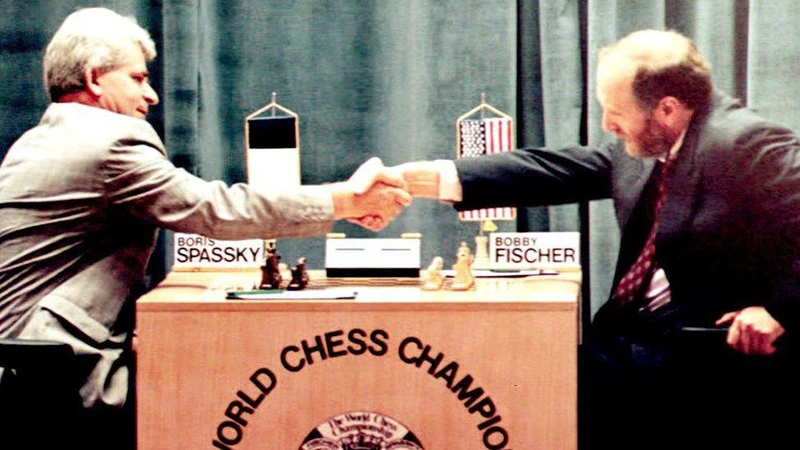
 Credit: Jerry Cooke/Getty Images
This was Fischer's first game in twenty years and he played flawlessly. People were excited to see that Fischer had not lost the magic and wondered about the possibility of Fischer returning fully to chess.
Host: Mr. Fischer, first of all, congratulations. What is your first impression after the game?
Fischer: Yes, I had the opening advantage. It was a good opening, yes it was, basically, and then I created serious difficulties later on. I found a way, I think it was a pretty good game.
Spassky: Yes, it was a pretty good game. But in the opening,I think White just got most space and some advantage and I think I missed to find the best plan. And after that my partner played very well. Very consequently, proving the advantage, finding a very nice plan, and eventually I was "killed."
Host: What do you think was the crucial mistake of Mr. Spassky in this game?
Fischer: I don't want to say, because we'll be playing a lot of chess, I can't tell everything.
Bobby Fischer, No Regrets, Yasser Seirawan and George Stefanovic, (p.33), 1992, Fischer-Spsasky Rematch Game 1 Press Conference, September 2, 1992
In the second game Fischer once again got a winning position. Unfortunately, the side effect of not playing chess for 20 years showed up and he blundered a winning position in the endgame. After a draw in Game 3, Spassky won the next two games back to back, leading with 2 wins against Fischer's 1.
My general approach was not to think about the result of the match but how to help Bobby to restore his best form. The sixth game was critical. I was playing for a draw with white, but Bobby played so badly that I achieved a winning position. This would, of course, give me a real chance to lead with three wins and two draws!
Could Bobby withstand such a situation? I did not know and this created a difficult psychological situation for me. I wanted to win the match but I was afraid to win: Bobby could simply leave the match and abandon chess forever. This uncertainty prevented me from winning [the sixth game]. Bobby saved the game with his fighting spirit, and his creative capacity was restored. His self confidence returned and [from that point on] he began to play much better.
Boris Spassky, Frank Brady, Endgame, 2011, (p.256)
Fischer bounced back with 3 wins in a row from Games 7-9. At the start of Game 11, the score was 4-2 in wins to Fischer.
Host: "It's the end of the first half of the match. What is the short story about this game?"
Fischer: "Well, I think I made an innovation, I'm not sure. That was 7.b4. And then, I had the better of it. Boris played 12.Qd7, that was a lemon."
Spassky: "Probably my best defensive plan was pawn d6 and after that to take on d4."
Fischer: "I think I had an edge, I wasn't sure."
Host: "Tomorrow we will have a press conference but maybe you could answer just one question. Were you thinking a lot before b4, did you find it at the board?"
Fischer: "Yes, I found it at the board, perhaps I looked at it once before, I don't remember. You see a game, you look at something and then you forget it."
Spassky: "I think it was Bobby's innovation during the game."
Bobby Fischer, No Regrets, Yasser Seirawan and George Stefanovic, (p.112), 1992, Fischer-Spsasky Rematch Game 11 Press Conference, September 20, 1992
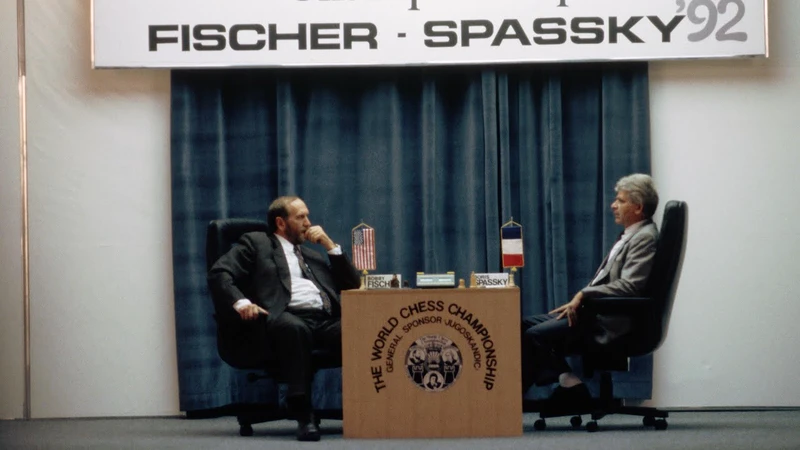
After Game 11, they took a ten day rest and then moved to play the second half on the match in Belgrade. Since Fischer scored his 5th win in Game 11, and the match was first to 10 wins, Game 11 counted as the completion of the first half.
Spassky won Game 12. Fischer scored two consecutive victories in Games 16 and 17. Spassky won Game 20, and Fischer won Games 21 and 25. Before Game 26 the score was 9-4 to Fischer. If Fischer won one more game he would win the match.
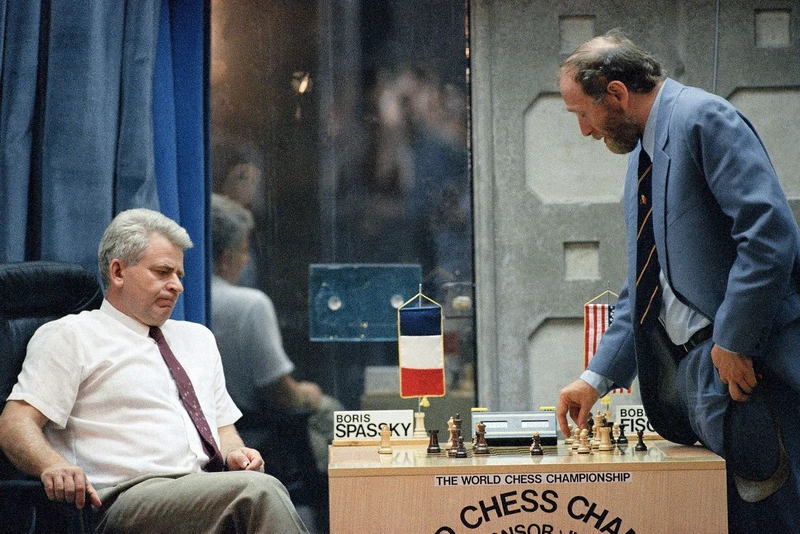
Before Game 30 after 3 draws, the score was 9-5 to Fischer.
The end itself was touching. Fischer heard thundering ovations again, just like in the beginning of the Belgrade part of the match. The actors, together with Vasiljevic and chief arbiter Lothar Schmid, came before the audience. Schmid handed Fischer a bay wreath, traditionally dedicated to World Champions, and also thanked the players for their fair play and the organizers for the wonderful conditions they had provided.
Bobby was very excited. He was barely able to standup from the table; eye witnesses claimed that there were tears in his eyes. Still, he calmed down somehow and turned to the audience: "Many thanks to all of you who had been coming here to watch us. You were a great audience and I hope that soon we'll meet here again." And when he said in fluent Serbian "Thank you very much and goodbye!" it seemed that the Sava center would crash down from the applause.
Bobby Fischer, No Regrets, Yasser Seirawan and George Stefanovic, (p.267), 1992
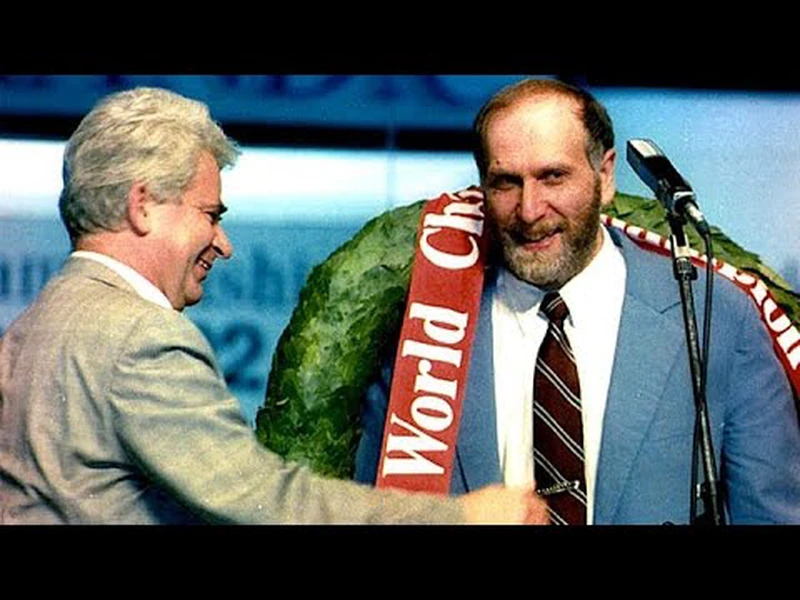
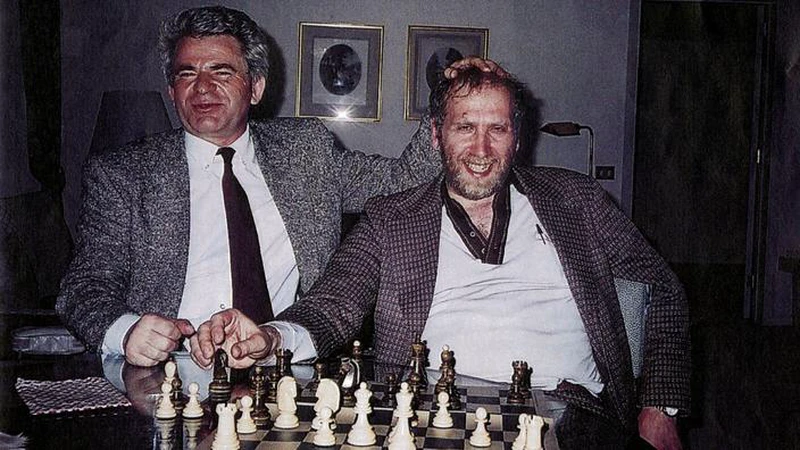
 Source: Color photo version created by the developer of https://bobby-fischer-1992.blogspot.com
1993-2008
Due to the U.S. government's sanctions on Yugoslavia which banned commercial activities by U.S. citizens, going back to the U.S. would mean imprisonment. So Fischer chose to live in Hungary. He lived with the Polgars for a time and also hung out with Andre Lilienthal. In the early 2000's Fischer would often travel between Japan and the Philippines. On July 13, 2004, Fischer was forcefully taken from Narita airport in Toyko to a jailcell, allegedly for traveling on a revoked passport. Spassky sent a letter to George Bush to get the attention of the chess world and help Fischer:
Mr. President,
In 1972 Bobby Fischer became national hero. He smashed me in the match in Reykjavik. The Soviet chess hegemony collapsed. One man won against a whole army. Soon after that Fischer stopped playing. He repeated the sad story of Paul Morphy. At the age of 21, legendary Paul had beaten all leading European masters and became unofficial champion. He stopped playing and finished his tragic life at the age of 47 in New Orleans in 1884.
In 1992, twenty years after Reykjavik, there was a miracle. Bobby resuscitated and we played a match in Yugoslavia. But at that time there were sanctions against Yugoslavia forbidding American citizens any sort of activity on the territory of Yugoslavia. Bobby violated the instructions of the State Department. He became the subject of a warrant for arrest issued on December 15, 1992 by the US District Court. As for me, as a French citizen since 1978, I did not get any sanctions from the French government.
Since July 13, 2004, Bobby has been detained at Narita airport on immigration violations. Further events have been described by media.
It is clear that the law is the law. But Fischer’s case is not usual. I am an old friend of Bobby since 1960 when we played in Mar-del-Plata and shared 1-2 places. Bobby is a tragic personality. I realized this at that time. He is an honest and good natured man. Absolutely not social. He is not adaptable to everybody’s standards of life. He has a very high sense of justice and is unwilling to compromise as well as with his own conscience as with surrounding people. He is a person who is doing almost everything against himself.
I would not like to defend or justify Bobby Fischer. He is what he is. I am asking only for one thing. For mercy, charity.
If for some reason it is impossible, I would like to ask you the following: Please correct the mistake of President François Mitterand in 1992. Bobby and myself committed the same crime. Put sanctions against me also. Arrest me. And put me in the same cell with Bobby Fischer. And give us a chess set.
Boris Spassky
10-th Chess World Champion
08.07.2004
In the meantime a Free RJF Committee was formed whose members (supporters from Iceland) helped Fischer by convincing the Icelandic parliament to grant Fischer citizenship to stop the U.S. from extraditing him. After spending nine months in prison, Fischer was released on March 23rd, 2005 and flew to Iceland where he lived for the rest of his life. Spassky sent a letter of gratitude to Einar Einarsson, the head of the RJF Committee.
Dear Einar,
Thank you very much for very good news. Now when the whole chess world is cowardly silent, Icelandic people made a natural and brave move to help Bobby. Congratulations. And my applause! If you need my assistance or help, please let me know. I will join with great pleasure the group of brave Icelandic people.
I take the opportunity wish you all a Merry Christmas and a Happy New Year.
Boris and Marina Spassky
Fischer and Spassky remained in contact with each other till the very end. Only three weeks before Bobby’s death Spassky had sent his old friend a lighthearted message, telling him to obey his doctors, and that when he “escaped” from the hospital, he should get in touch. Spassky had been informed that Bobby’s condition was serious, but he wasn’t aware that it was grave. Icelandic tradition discourages a person’s illness from being discussed outside of family or intimate friends, but because of Spassky’s solicitous comments about his longtime opponent, Einarsson considered him a part of Bobby’s “family” and had let him know his friend’s condition was worsening. Spassky wrote: “I have a brother’s feeling toward Bobby. He is a good friend.”
Frank Brady, Endgame, 2011, (p.321)
Q: What did you last discuss with Fischer?
"What first move was stronger: e2-e4 or d2-d4. We agreed that it's the latter, because the pawn is protected by the Queen. Bobby always called me. I've never bothered him by the phone. I knew that he would again start discussing his own "Fischer chess" with me. I didn't approve of the idea. Too many variants. But he insisted."
Boris Spassky, Yuri Golyshak and Sergei Kruzhkov Interview, Sport-Express, 2016
Fischer passed away on January 17th, 2008 at the age of 64. Spassky emailed Einar Einarsson saying "My brother is dead".
Q: Did you attend Fischer's funeral?
"I couldn't - my French wife didn't let me. Later, when I visited Reykjavik, I brought some flowers to his grave. Fischer planned his funeral beforehand - what music to play, whom to invite. He invited only three chess players: Andor Lilienthal, Lajos Portisch and me."
Boris Spassky, Yuri Golyshak and Sergei Kruzhkov Interview, Sport-Express, 2016
When he visited Fischer's grave he commented: "Do you think the spot next to him is available?". Spassky passed away on February 27th, 2025 at the age of 88.
Final Thoughts
Bobby Fischer and Boris Spassky were two remarkable men with an even more remarkable friendship. The dynamic and outspoken Fischer and the sympathetic and philosophical Spassky. Two World Champions with an improbable bond. Their friendship lasted for decades. But they also had a competitive rivalry in the 60's, leading to its culmination in the 1972 World Chess Championship Match. This produced a very interesting tension in their relationship. Vlastimil Hort said that Fischer would refer to Spassky as his 'frenemy', which is the best word to describe their dynamic. We will never forget their games which have brought so much joy to the world, as well as their incredible friendship.
Sources
- Bobby Fischer Wikipedia
- Boris Spassky Wikipedia
- Fischer 1973 Photos and Info (1)
- Fischer 1973 Photos and Info (2)
- Fischer 1975 World Championship Info
- 1992 Rematch Games
- Yasser Seirawan and George Stefanovic, No Regrets, 1992
- Boris Spassky letter to George Bush, 2004
- Boris Spassky letter to Einar Einarsson, 2004
- Boris Spassky, Kirill Zangalis Interview, Soviet Sport, 2010 (Tranlated by MISHANP)
- Boris Spassky, Yuri Golyshak and Sergei Kruzhkov Interview, Sport-Express, 2016 (Translated by User Spektrowski)
- Ian Rodgers, Vlastimil Hort Interview
- Adolivio Capece, Fischer – Spassky 20 years later: the 1992 match in Yugoslavia, 2022
- Luke McShane, Remembering Spassky, The Spectator, 2025
- Frank Brady, Endgame, 2011
Visit Blog Creators Hangout for more featured blogs.
You may also like
 thibault
How I started building Lichess
I get this question sometimes. How did you decide to make a chess server? The truth is, I didn't. RuyLopez1000
What Will Become of Humanity?
Take a front row seat as you watch your Chess Heroes get ripped apart by Engines. RuyLopez1000
Bishop vs Knight: The Eternal Battle
Which piece is better: the knight or the bishop? (A question as old as time itself) RuyLopez1000
Daniel Naroditsky: The Legend
Remembering one of the icons of the modern era. RuyLopez1000
One of The Greatest Games Ever Played
Yuri S. Gusev vs E. Auerbach 1946 RuyLopez1000