
How to Think in Critical Positions?
What should you do when the opening is over? That is the moment where many games are decided. There is no theory anymore, no memorized moves - you have to think for yourself.In this post, I show a simple way to think in critical positions and how to build a clear plan during the game.
This is exactly the same process I use in my own games and with my students.
I use a thinking method based on 10 steps: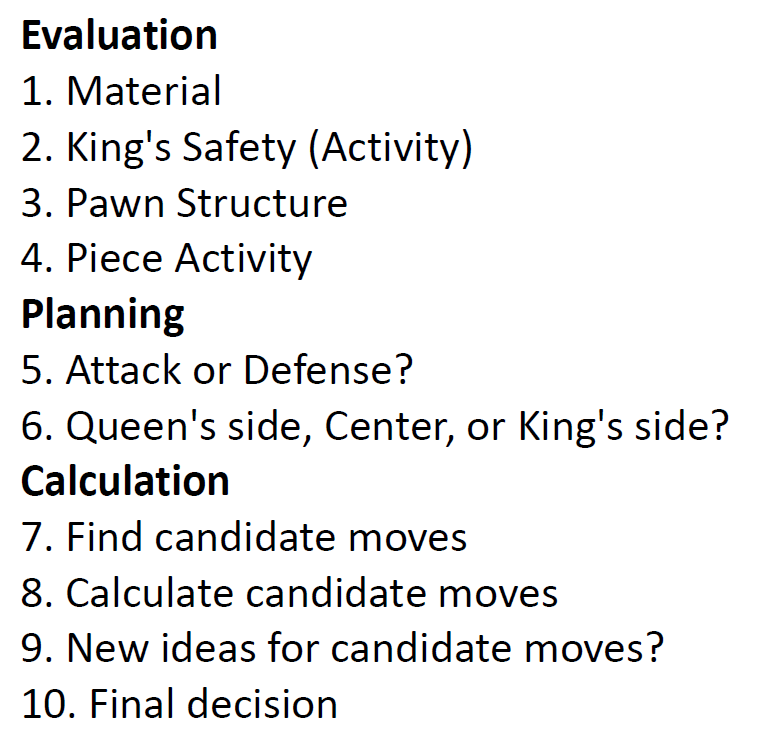
If you want to download the free guide explaining the full theory, you can get it here:
https://createthebestplan.matbobula.com/
So now let’s go to the practical part.
Recently, I played three games and explained my thinking process step by step.
Let’s take a look at the first position after the opening.
I. EVALUATION
1. Material - White is up one pawn.
2. King safety - Both kings are safe.
3. Pawn structure - White has a queenside pawn majority, and Black has an isolated pawn on a6. White has the advantage.
4. Piece activity - Equal.
Summary: White is better due to the extra pawn, the queenside pawn majority, and Black’s isolated pawn.
II. PLAN
5. Attack - The position is better for White.
6. On the queenside - Most of the advantages are on that side.
III. CALCULATION
7. Candidate moves - Na4 or Rhc1.
8. Calculation:
- 1. Na4 Ne4 2. Rhc1 with a big advantage for White (although Ne4 is annoying).
- 1. Rhc1 0-0 2. a3 with a big advantage for White and no counterplay for Black.
9. New ideas? Ne5, but it does not follow the plan, so I can reject it.
10. Decision - 1. Rhc1.
Below, you can find the position from the third game, so you can practice this method yourself.
Once you complete it, you can compare your thinking with mine in the video (the position starts at 42:26).
You may also like
 IM MatBobula
Your Weekly Chess Lesson
Happy New Year! RuyLopez1000
How Meditation Can Help Your Chess
It teaches the Ego a lesson. IM MatBobula
Is Opening Theory Really Overrated?
One of my students recently asked me a very good question: If opening theory is over exaggerated, wh… IM MatBobula
A Complete, Rock-Solid Opening Repertoire for Every Player
Today I’ll walk you through a rock-solid opening repertoire you can start using immediately. No heav… IM MatBobula
Calculate like Fischer!
In this post, we’ll look at one of the most important chess skills: calculation. To keep it simple, … FM MattyDPerrine