Comments on https://lichess.org/@/hollowleaf/blog/opponent-prep-updated/uk1kdQWg
This is all nice and all, but what does it mean in practice?
Let us say you find out your opponent always plays e.g. Englund Gambit. OK so you just look up the refutation of the Englund Gambit and prepare that to win.
Let us say you find out your opponent always plays e.g. Grünfeld Indian Defense. Now what? Are you going head to head on theory with the player having much more experience with it? Are you going to avoid it and thus not play what you usually play?
This is all nice and all, but what does it mean in practice?
Let us say you find out your opponent always plays e.g. Englund Gambit. OK so you just look up the refutation of the Englund Gambit and prepare that to win.
Let us say you find out your opponent always plays e.g. Grünfeld Indian Defense. Now what? Are you going head to head on theory with the player having much more experience with it? Are you going to avoid it and thus not play what you usually play?
@tpr said:
This is all nice and all, but what does it mean in practice?
Let us say you find out your opponent always plays e.g. Englund Gambit. OK so you just look up the refutation of the Englund Gambit and prepare that to win.
Let us say you find out your opponent always plays e.g. Grünfeld Indian Defense. Now what? Are you going head to head on theory with the player having much more experience with it? Are you going to avoid it and thus not play what you usually play?
For the most part, that is up to you, the application provides you with information.
It is not really a teaching tool, but allows you to go into the game with knowledge and the ability to prepare, maybe you can find lines in your games where your opponent does not do so well, and therefore can drive the game into that direction for example,
@tpr said:
> This is all nice and all, but what does it mean in practice?
>
> Let us say you find out your opponent always plays e.g. Englund Gambit. OK so you just look up the refutation of the Englund Gambit and prepare that to win.
>
> Let us say you find out your opponent always plays e.g. Grünfeld Indian Defense. Now what? Are you going head to head on theory with the player having much more experience with it? Are you going to avoid it and thus not play what you usually play?
For the most part, that is up to you, the application provides you with information.
It is not really a teaching tool, but allows you to go into the game with knowledge and the ability to prepare, maybe you can find lines in your games where your opponent does not do so well, and therefore can drive the game into that direction for example,

I don't "drill" or do spaced repetition on my openings. Instead, I generally work on my openings either when I prepare for a match (Dojo tournaments, Lichess Ladders, etc.), when I analyze my games, or when I play correspondence chess. During all of that I will frequently update my repertoire files. When I prepare for a match, I do two things. First, I use tools like this to compare my repertoire to my opponent games and see if I can get a sense of what variations I am likely to face. Next, I play simulated games against the opponent using a bot tool that plays from their database moves such as the practice module in Repertoire Builder. I find that this approach works well for me. I complement this by reviewing deviations I make from my opening files in my rapid/blitz/bot games (e.g., using the Opening Deviations tool in repertoire builder). I find the suite of tools very useful.
I don't "drill" or do spaced repetition on my openings. Instead, I generally work on my openings either when I prepare for a match (Dojo tournaments, Lichess Ladders, etc.), when I analyze my games, or when I play correspondence chess. During all of that I will frequently update my repertoire files. When I prepare for a match, I do two things. First, I use tools like this to compare my repertoire to my opponent games and see if I can get a sense of what variations I am likely to face. Next, I play simulated games against the opponent using a bot tool that plays from their database moves such as the practice module in Repertoire Builder. I find that this approach works well for me. I complement this by reviewing deviations I make from my opening files in my rapid/blitz/bot games (e.g., using the Opening Deviations tool in repertoire builder). I find the suite of tools very useful.
Could this project be extended for on the board chess?
So instead of import and compare 2 online profiles, you import and compare 2 pgns from 2 players.
Such tool would save me a lot of time as today I do this manually when preparing for games.
A next step would be to combine your tool with finding winning novelties/ variations. For this there are already tools existing:
ChessPath.Pro
https://github.com/rooklift/nibbler
https://lichess.org/@/LKama/blog/finding-opening-gold-a-statistical-hunt-for-wicked-lines/c0x9TFV7
Could this project be extended for on the board chess?
So instead of import and compare 2 online profiles, you import and compare 2 pgns from 2 players.
Such tool would save me a lot of time as today I do this manually when preparing for games.
A next step would be to combine your tool with finding winning novelties/ variations. For this there are already tools existing:
ChessPath.Pro
https://github.com/rooklift/nibbler
https://lichess.org/@/LKama/blog/finding-opening-gold-a-statistical-hunt-for-wicked-lines/c0x9TFV7
@mvhk said:
Could this project be extended for on the board chess?
So instead of import and compare 2 online profiles, you import and compare 2 pgns from 2 players.Such tool would save me a lot of time as today I do this manually when preparing for games.
A next step would be to combine your tool with finding winning novelties/ variations. For this there are already tools existing:
ChessPath.Pro
https://github.com/rooklift/nibbler
https://lichess.org/@/LKama/blog/finding-opening-gold-a-statistical-hunt-for-wicked-lines/c0x9TFV7
Yes, I am going to extend this in the future to allow for the upload of PGNs, as a few people have messaged me about that as well.
The current tool is a good starting point, I am in the middle of developing a full dossier tool, with all the analytics bells and whistles, the initial version of this will be available for alpha testing in the next few weeks.
@mvhk said:
> Could this project be extended for on the board chess?
> So instead of import and compare 2 online profiles, you import and compare 2 pgns from 2 players.
>
> Such tool would save me a lot of time as today I do this manually when preparing for games.
>
> A next step would be to combine your tool with finding winning novelties/ variations. For this there are already tools existing:
> ChessPath.Pro
> https://github.com/rooklift/nibbler
> https://lichess.org/@/LKama/blog/finding-opening-gold-a-statistical-hunt-for-wicked-lines/c0x9TFV7
Yes, I am going to extend this in the future to allow for the upload of PGNs, as a few people have messaged me about that as well.
The current tool is a good starting point, I am in the middle of developing a full dossier tool, with all the analytics bells and whistles, the initial version of this will be available for alpha testing in the next few weeks.
At least as important than W/D/L is the ratingloss/win expected per game. You can have a low score but still win rating because you play against much better players.
The tool could say based on W/D/L good to play against the opponent but in reality it is a bad choice because you are expected to lose rating.
At least as important than W/D/L is the ratingloss/win expected per game. You can have a low score but still win rating because you play against much better players.
The tool could say based on W/D/L good to play against the opponent but in reality it is a bad choice because you are expected to lose rating.
@mvhk said:
At least as important than W/D/L is the ratingloss/win expected per game. You can have a low score but still win rating because you play against much better players.
The tool could say based on W/D/L good to play against the opponent but in reality it is a bad choice because you are expected to lose rating.
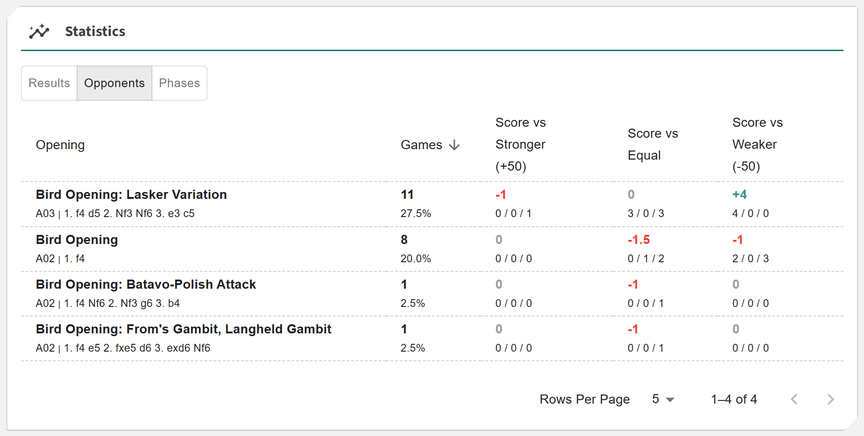
That is a great point, I should take expected win (based on the elo difference) into account; I have done something similar in UserScout, so will look to incorporate this into the Opponent Prep.
@mvhk said:
> At least as important than W/D/L is the ratingloss/win expected per game. You can have a low score but still win rating because you play against much better players.
> The tool could say based on W/D/L good to play against the opponent but in reality it is a bad choice because you are expected to lose rating.
That is a great point, I should take expected win (based on the elo difference) into account; I have done something similar in UserScout, so will look to incorporate this into the Opponent Prep.
