
https://commons.wikimedia.org/wiki/File:Paul_Morphy_Daguerreotype.jpg
The Genius of Paul Charles Morphy
Paul Charles Morphy's Opera Game, his life, and his influence in chess.It is no secret, that Paul Charles Morphy is my favorite chess player. But, why exactly is that? Why is Morphy regarded as a chess genius? And does this term, this title, still hold up in modern times, where Romantic chess with gambits is rarely seen on the top level, where we have seen the likeness of Fischer and Kasparov and so many other great chess masters?
First of all, we need to know a little bit about Paul Charles Morphy, before we will examine his immortal and famous game - the Opera Game!
Paul Charles Morphy
Paul Charles Morphy was born on June 22, 1837 in New Orleans, Louisiana.
He was born into a wealthy family with his father, Alonzo Michael Morphy, being a lawyer, who also served as Attorney General of Louisiana and Louisiana State Supreme Court Justice. Alonzo was of Irish, Spanish and Portuguese ancestry. Paul's mother, Louise Thérèse Félicité Thelcide Le Carpentier, was musically talented and came from the Creole family. On sunday gatherings, chess and music was prominently featured.
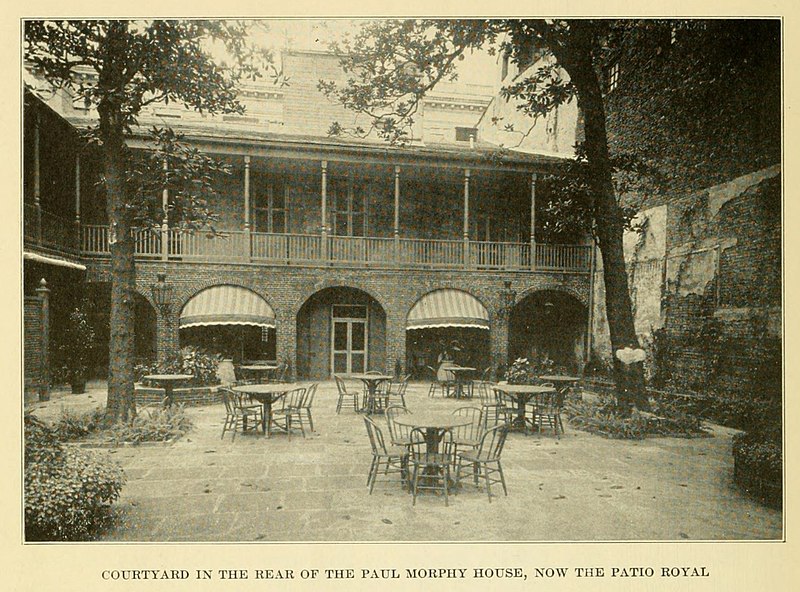
But enough on the background of Morphy: Let us look on how exactly he discovered chess:
No one ever formerly thaught Morphy to play chess (according to Morphy's uncle Ernest) - he just learned how the pieces moved by simply watching other people - his father and uncle - play chess: He even learned strategic ideas solely through watching! There's the famous incident, where Ernest and Alonzo played a game and both agreed on a draw - suddenly, young Paul stepped in and explained, that his uncle should not have agreed to a draw, because he was winning. Morphy not only claimed and explained the win, but also set up the pieces in the according position and demonstrated how Ernest could have won.
Now his family knew, that Morphy had a special talent - thus they encouraged him to play the "Game of Kings" (or as it is more often called: "Chess"). Young Morphy played in family gatherings and in the local chess climate - and Morphy soon became known as the strongest player in town: He defeated General Winfield Scott, when he came through New Orleans and demanded a strong Opponent: Morphy was 9 years old at that time (1847) and Scott was at first offended, that he was being made fun of since such a young boy was chosen as his Opponent. Nevertheless, Morphy defeated him in both games they played.
At the age of 12, Morphy played 3 games against Johann Jacob Löwenthal, a hungarian chess master, who had defeaten all sorts of young prodigies - but not Morphy!
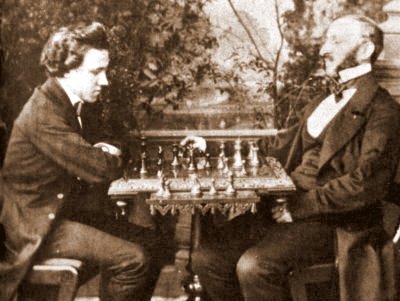
Löwenthal quickly realzed, that Morphy was a formidable Opponent - in the end, Morphy won at least two games while at least drawing the one game, winning 2,5-0 (or as some accounts claim, Morphy won all three games, winning the match 3-0)
Morphy didn't play much chess, due to studying and eventually graduating in 1854 from Spring Hill College in Mobile, Alabama. He stayed an extra year to study Mathematics and Philosophy before studying law at the University of Louisiana - he received an L.L.B degree in 1857. But as he wasn't old enough to begin his work as a lawyer, thus he had a lot of spare time on his hands - and this would be used for chess!
He received an Invitation to the First American Chess Congress and, although he declined at first, he decided to play due to the urging of his uncle Ernest. And: Morphy defeated all of his Opponents! In the final round he defeated Louis Paulsen, one of the stronger Opponents at the American Chess Congress.

Although Morphy now was the first Chess Champion of the United States, he didn't change because of the sudden fame. He stayed in New York for autumn 1857 and played a total of 261 games of chess - including games with odds like Rook-odds or Knight-odds (so he would play at an disadvantage in these odds games). He also played some standard games in New York:
| Wins | Draws | Losses | Total Standard Games |
|---|---|---|---|
| 87 | 8 | 5 | 100 |
Morphy, now the first Chess Champion of the U.S., still wasn't highly regarded in Europe. You see, most chess masters - like Löwenthal - came from Europe and Morphy wasn't well known there. And because the European Masters wouldn't go on a journey to the U.S. to play the few masters, whom they didn't even know, over there, there was only one solution to challenge the old and strong European masters: To go on a trip in Europe!
After Morphy returned home, the New Orleans Chess Club determined, that a challenge should be made to european chess master Howard Staunton. (Staunton himself may have been the strongest chess master from 1843 to 1851.) Staunton made a reply stating, that Morphy would have to come to europe if he wanted a match - and so Morphy did exactly that - he went to europe and played against the great chess masters of his time.

But, once in England, Morphy tried to set up a match against Staunton numerous times - but the match never took place. Staunton was blamed for avoiding the match, while he blamed Morphy for not having the funds necessary to play a match with high stakes. Though Morphy opposed the idea of playing chess for money, he'd most likely would have had the funds due to his fame. Nevertheless, Morphy played against other european masters.
In France, Morphy defeated Daniel Harrwitz, a german master. Due to illness and the treatment of his illness, Morphy lost a lot of blood and wasn't able to stand up without assistance, but still went on to play german master Adolf Anderssen, who may have been Europe's strongest player at that time. The 21 year old Morphy defeated Anderssen in their match:
| Wins | Draws | Losses | Total Games played |
|---|---|---|---|
| 7 | 2 | 2 | 11 |
Although Anderssen claimed to be out of shape, he also stated that Morphy was the strongest chess player to have lived.
While in Europe, Morphy also held numerous simultaneous exhibitions and played blindfolded. It's also in this time, he played the well known, and maybe the most famous chess game, that beautifully teaches the importance of the initiative: The Opera Game:
And it also was in Europe, in Paris and London, where Morphy was proclaimed the chess "Champion of the World" - a title, that wouldn't exist for roughly 33 years. On his way back home he also toured major cities and once again was proclaimed "Chess Champion of the World". Morphy announced, that he wouldn't play any games without the odds of a pawn and a move, due to the lack of serious opposition. And soon Morphy retired from chess...
Morphy's career as a lawyer was disrupted by the American Civil War, but even after the War he wasn't able to built a successful career as a lawyer - his clients wanted to talk more about chess than their legal affairs. Later he met Wilhelm Steinitz, although he only met him under the condition, that they wouldn't discuss chess. Morphy later lapsed into a state of paranoia, but was still able to argue for his rights, so he wouldn't get send to a sanitarium. Morphy died on July 10, 1884, aged 47, because of a stroke.

Morphy is regarded as one of the strongest players to ever live, given that he dominated his fellow chess masters with ease. And although he only was an active chess player for a few years, he's also one of the most popular and beloved players ever. He is often called the "Pride and Sorrow of Chess" and many masters and world champions (in particular Euwe, Kasparov and Anand) think, that he was far ahead of his time. Fischer even said, that Morphy could, given the time to study modern theory and ideas, beat any player of any era! Fine disagreed with Fischer, but also stated, that:
"He was so far ahead of his rivals that it is hard to find really outstanding examples of his skill... Even if the myth has been destroyed, Morphy remains one of the giants of chess history."
Kasparov emphasizes, that Morphy realized the importance of fast developement of the pieces, the importance of the domination of the center and the importance of opening lines a quarter century before Steinitz formulated these principles. Kasparov also states, that Morphy is the "forefather of modern chess" and "the prototype of the strong 20th-century-grandmaster".
I hope, that you enjoyed this Blog post about Paul Charles Morphy. Maybe you have learned something new, maybe you are now eager to know more about this great chess player. Anyways, have a nice day!
Sources used for the text:
Sources used for the pictures (in order of appearance):
- https://commons.wikimedia.org/wiki/File:Paul_Morphy_Daguerreotype.jpg
- https://commons.wikimedia.org/wiki/File:Paul_Morphy_House.jpg
- https://commons.wikimedia.org/wiki/File:Morphy_L%C3%B6wenthal_1858.jpg, https://commons.wikimedia.org/wiki/Commons:Copyright_tags/Country-specific_tags#United_States_of_America
- https://commons.wikimedia.org/wiki/File:First_American_Chess_Congress_(BM_1871,0429.9).jpg, https://commons.wikimedia.org/wiki/Commons:Copyright_tags/Country-specific_tags#United_States_of_America
- https://commons.wikimedia.org/wiki/File:Paul_Morphy.jpg, https://commons.wikimedia.org/wiki/Commons:Copyright_tags/Country-specific_tags#United_States_of_America
- https://commons.wikimedia.org/wiki/File:PaulmorphyHair.jpg, https://commons.wikimedia.org/wiki/Commons:Copyright_tags/Country-specific_tags#United_States_of_America


.jpg)


No Copyright infringement intended! All rights go to their respective owners - I do not own any of these pictures! If I have violated any copyrights I will take down the blog post immediately.
You may also like
 MenacingFierceTiger
Chess explained in 200 words
In this blog I'm going to be explaining chess in 200 words, don't spend time counting all of the wor… george_mcgeorge
My favorite Openings
My "top 10" and some advices on Openings george_mcgeorge
Breathe!
"Breathe in the air - don't be afraid to care" piazzai
Do Variants Help You Play Better Chess? Statistical Evidence
You spent hours racing kings, nuking knights, and fending off pawn hordes. Cool! But will any of thi… george_mcgeorge
Chess pieces: The King
In this blog series (yet another new one!), we will focus on the pieces that roam the 8x8 world. And… george_mcgeorge