
How to work on the middlegame?
Middlegame training is no different than tactical training. It's all about training our thought process and patterns. In this article we will explore different methods to acquire knowledge about middlegame.
The importance of opening knowledge
For players rated 2300 and above, opening theory becomes increasingly critical. At this level, having a solid grasp of openings can significantly impact performance. However, this does not mean that players at lower levels should neglect this phase of the game.
In my own experience, studying openings has been immensely beneficial. When I focused on the King's Indian Defense, I didn’t just memorize moves—I delved into the core ideas and strategies behind the setup. For example, understanding the nuances of closing the center with f5 and f4, then advancing with g5, Ng6, Rf7, and Bf8, provided me with deeper insights into the typical middlegame positions arising from this defense. This approach enhanced my understanding of critical chess principles like sacrifices for activity, dynamic play against the center, and the significance of having a coherent plan.
When you thoroughly study an opening, you familiarize yourself with the most common positions and ideas that arise from it. This preparation allows you to approach the middlegame with confidence and clarity, rather than facing random positions that you haven't prepared for. By identifying and analyzing the typical responses and setups from your chosen openings, you can significantly improve your in-game decision-making and overall chess understanding.
Studying openings has never been easier than it is today. Courses on modernchess, chessable, chessbase, engine help, opening tree - all these tools facilitated learning process.
Practice with engine on lichess
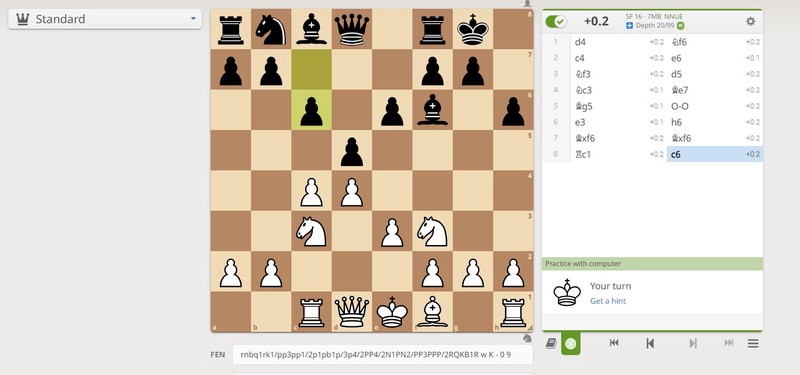
Open the Analysis Board: Go to "Tools" and select "Analysis Board" in your chess software.
Activate Engine Practice: Click on "Practice with Engine." This feature lets you play against Stockfish, giving you a realistic and high-level opponent.
It's real Stockfish, not some bots with levels 1-8. We want to see how engine poses problems. Let's say, we take a position we tend to get very often, QGD Bg5 line. I want to understand how to play next 10-15 moves against different responses. If I want to know how to play with White these positions, I should play against engine with Black to see how it beats me. Try different moves that you think your opponent can utilize against you.
I remember I could explore one line for hours trying out different ideas. After one session like that , I was thinking, oh, it is so hard to play for black here, humans will definitely suffer if I suffered!
Analyse critical positions
Go through your game or game by any player you like and find a position where you were unsure what to do and how to continue. Play it out with engine , understand main ideas, learn new patterns.
I played a blitz game, then checked this position after the opening. Learned a new idea, g5-g4 expansion. I would have never thought of it. Now I know that such ideas make sense. Try to learn these kind of patterns from every game you play.
Be curious, analyse positions that could happen and those you feared to face.
Positional pictures
Compile the mini-ideas you learn into a single file and keep building on it over time. In a month or two, you'll accumulate a substantial collection of positions and ideas that challenged you. This process can be enjoyable, as it allows you to track your progress and see your improvement firsthand. Plus, you'll always have a reference to review and reinforce what you've learned.
Bd8-Bc7 small positional operation that improved Black's position. The more ideas like that you have accumulated , the better decisions you will make in the middlegame.
Active learning
For chess enthusiasts who enjoy streaming, blitz, and following tournaments but also want to be productive, here’s a strategy to blend enjoyment with improvement:
- Save Interesting Positions: Whenever you encounter a fascinating position—whether in streams, games, or tournaments—take a snapshot or note of it. Capturing these moments helps in focusing on positions that intrigue you and can offer learning opportunities.
- Reflect and Analyze: Spend time analyzing these saved positions. Challenge your own thought process by considering different moves and strategies. This reflection will deepen your understanding of various chess concepts.
- Verbalize Your Insights: Articulate what you’ve learned from each position. Whether you write it down or discuss it with others, verbalizing your thoughts helps consolidate your understanding and identify any gaps in your knowledge.
- Learn from Strong Players: If you follow strong players like Hikaru Nakamura, use their games as a learning tool. Capture key moments from their games and analyze them. Compare your analysis with how they approached the positions to gain insights into their thought processes and strategies.
These ideas worked for me and hopefully will work for you. If you have other interesting methods, you are welcome to share!
Join my telegram channel where I post interesting things on a regular basis. Level: 1800+ FIDE https://t.me/learnchess03
You may also like
 WFM fla2021
Endgame Tips That Might Change Your Life...Or Not!
In this post you will find some important tips to improve your endgames without having to study that… GM fairchess03
Three Essential Elements of Effective Chess Training
Effective chess training relies on mastering three key elements: analytical skills, consistency, and… GM fairchess03
Transformative Mindset Tips for Pros
In the intricate world of chess, mindset isn't just a component—it's a cornerstone of success. Today… jk_182
Finding Pawn Breaks automatically
Difficult concepts like pawn breaks are best understood when looking at many examples. But finding t… GM fairchess03
How to analyse games?
Analyzing your games is essential for chess improvement. Regularly reviewing each game you play—whet… jk_182