
Three signals of future strength in chess
Trainable behaviours I noticed while giving a simul at the Australian JuniorsI played a simultaneous exhibition against 15 players at the Australian Junior Chess Championships.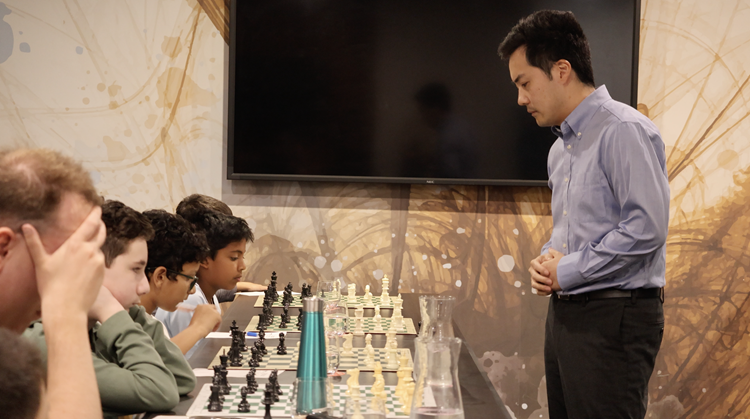
Battling against and seeing junior players up close made me think about a word we use a lot in chess: talent.
I’m wary of it because it can sound like something you’re just born with, but that’s not what I mean here.
What I’m talking about are indicators, the kinds of behaviours that tend to predict who will improve quickly, especially at the youth level.
Here are three signals that stood out:
1. Focus
The promising kids were locked in, thinking and calculating as much as possible.
There’s a certain look when someone is giving 100%, forgetting about the world around them.
I also observed that the stronger the player, the more they were thinking about what I’m aiming for, not only what they wanted to do.
The difference was stark with some kids who’d be chatting to their peers or be looking at the next board when I came back around to them.
2. Resilience
The best players kept fighting until the end.
Even in tough positions or even after losing material, they kept looking for the best moves and ways to cause me problems. To the very end, they would set traps and tried to make things as hard as possible for me.
At the junior level or amateur level, that habit alone wins or saves many more games than you might think. Opponents aren’t consistent at converting advantages and both sides are going to make some punishable mistakes or inaccuracies.
This doggedness is a key quality at the master level as well.
3. Competitiveness
While some of the kids were both focused and resilient, this one was rarer.
How much they care.
One of the U/8 kids who put up a great fight (maybe 55 moves) was emotionally invested in the game and was visibly upset when he lost.
Most weren’t too bothered. They were playing a master, after all.
But kids who go on to become the very best don’t care who they’re up against.
There’s a famous Fischer story where at age 7, he played against a master in a simul. Upon being crushed, he burst into tears. That game became a big motivator for him.
Players who improve quickly tend to be competitive. They don’t see time spent on chess as training, study or even trying to get better. They’re simply obsessed with chess, wanting to spend every waking minute on anything to do with the game.
A couple of the juniors asked me where they could have done better or about certain variations, and that’s also a sign that they want to learn as much as possible.
The U/8 boy who left the biggest impression on me looked timid and even about to cry before the game, but completely transformed the moment he played his first move. He even offered me a draw in a complex position where I was a couple of pawns down but had the initiative, maybe he could sense my uncertainty...
There was also an 8-year-old already close to 1800 FIDE, which is really impressive.
These three signals aren’t destiny.
- Many kids peak early
- Plenty start later and catch up
- Environment matters a lot.
But these three behaviours, focus, resilience and competitiveness are useful because they’re visible and trainable (though not overnight!).
They’re also a good reminder that what we call talent in chess is often just a set of habits showing up earlier than usual.
I also like to think of talent as the capacity for hard work and pushing yourself to keep learning and growing, because that could be the goal that a lot of people don't realise they should be pursuing.
These signals are useful for adults too.
- How do you rate your focus, resilience and competitiveness?
- What do you think of the word talent in chess?
Leave a comment and let me know.
Talent renders the whole idea of rehearsal meaningless; when you find something at which you are talented, you do it (whatever it is) until your fingers bleed or your eyes are ready to fall out of your head. Even when no one is listening (or reading or watching), every outing is a bravura performance, because you as the creator are happy. Perhaps even ecstatic.
—Stephen King, On Writing: A Memoir of the Craft
You may also like
 IM datajunkie
25 lessons from 25 years of chess
Mistakes you can avoid and habits you can start with today IM datajunkie
The 5 things I do before a tournament
Learnt from 25 consecutive years of OTB IM datajunkie
Why your tactics aren’t improving
The 4 fixes that can help you become a tactician IM datajunkie
Do this on your opponent's turn
5 simple habits to use your time better and level up your chess CM HGabor
How titled players lie to you
This post is a word of warning for the average club player. As the chess world is becoming increasin… ChessMonitor_Stats