
The philosophy of antichess
How can the opposite view of things help?
Greetings to all readers! Today is a rather unusual blog. Let me reflect a little on my vision of anti. No one is developing this topic, so why don't I start? :D
Let's go! :)
What is antichess?
Antichess is a variant of chess in which the main goal is to give away all your pieces. Even the king!
Yes, yes, the king is not an important figure here. So the game does not end after taking the king, you must give absolutely all the pieces (or stalemate)!
P.S. Castling is prohibited.
Sounds interesting, doesn't it? And it's even more interesting to watch the reactions of those who are not familiar with this game. After they see that the game continues without the king on the board (or at least that the king calmly stands under the "check"), their worldview begins to break.
Is it that simple?
It would seem like a cool and simple game. You can play it even if you just know how the pieces move.
But is it that simple?
When people hear that you have to "lose" here in order to win, they smile: "Ha, I would be a champion here! I lose classical chess all the time, so antichess is my element!"
And then there is a kink in the worldview of No2. They are left with almost a complete set of pieces after the end of the game.
"How so? Here you just have to give away your pieces..." :c
In fact, everything is much more difficult than it seems at first glance. In anti, as in classical chess, there are openings, tactical techniques, and counting positions (I hate queen race >.<)... So the opinion that this is a very simple game is erroneous. ^^
But here it's mostly just takeaways! It's a linear game! >:[
(Uh-huh... :])
Having a take rule doesn't make the game linear. Yes, the choice of moves at the moment is severely limited, especially in forced options, but after leaving the opening ...
Judging by this logic, some chess openings can also be called linear, since any unnecessary/erroneous move leads to big trouble. The Sicilian defense, for example. :P
But that doesn't mean that chess is now a linear game.
Anti is a positional game, and the ability to think strategically often plays a crucial role. Are strategic maneuvers exactly typical of the game we call linear? I don't think so. (¬_¬ )
And what about creativity? How can you create if you're so limited?
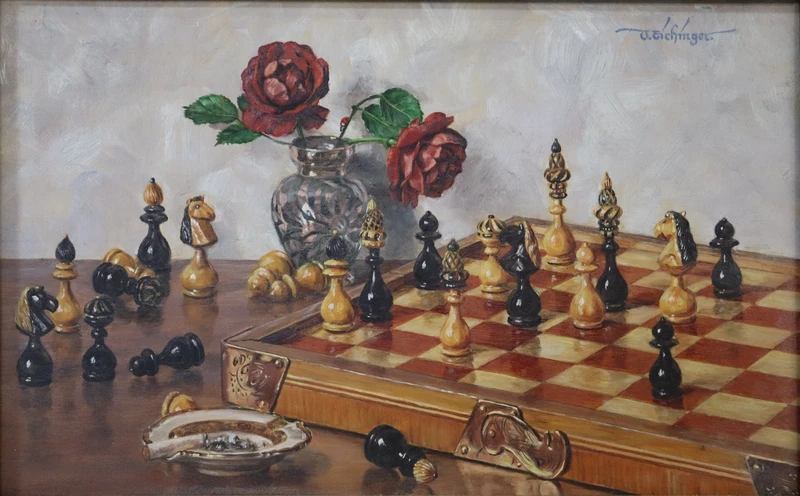
You can do anything if you want! :D
Can you stop the creator by taking away his brush and paints? I doubt.
Beethoven was known to be deaf. But he was able to compose a symphony even though he was already completely deaf. He just wasn't afraid to create and make mistakes. There
are many ways to create beauty on the board, ranging from a simple pawn roll to a fierce attack. You just don't have to play by the template. That's the whole secret.
If you want to better understand how you can create in anti, then I can advise you to try yourself in anti960. I think it will be interesting and unusual. ^_~
Is there any benefit from antichess? O_o
Definitely! With the help of anti, you can better understand chess. And maybe even your life. :)
But I'm too lazy to describe the full philosophy of antichess, and the blog itself is already quite large, so I'll go along the main line.
Antichess and chess are very closely related. But... It would seem that these are two opposites, it's not for nothing that the prefix "anti-" was added?..
So you are trapped in the mind. :P
Many people completely ignore this option because of the "anti-" prefix and consider it a "harmful" game.
Pfft, the conservatives. (¬_¬ )
Have you even tried to understand? :)
There are many techniques from classical chess in anti: playing against an insulator, lifting a rook, moving pieces to more active positions, zugzwang, pawn assault, etc. Techniques that work only in anti are also added: intermediate capture (here it has a slightly different meaning than in the classics), sacrifice of the king, double protection, safety of the figure ...
Coach, take note! ;)
How can antichess allow a better understanding of chess?
1. Due to the intertwining of techniques, you can look at the same position from different angles: chess and antichess. This allows you to expand your understanding, and the study becomes less one-sided.
2. The tempo is more valuable than in the classics.
This will make you appreciate the opportunities. Almost always, the moment is given only for one turn. This is mainly related to the take rule.
3. Some techniques have much more weight than in chess. For example, capturing a line. It is especially important who captures the line first, provided that both rooks are connected.
Поиск слабостей в позиции противника
There are very good examples of the techniques used here. I think you can easily find an echo of classical chess here. :)
After looking at the example from the studio, I think you realized how important it is to capture the line first. Again, in classical chess, this is also an important condition, but you can better highlight it with the help of anti.
4. Antichess is a good way to relax. Especially after chess. Quickly release tension and enjoy distraction, completely turning your understanding around. :D
Everything is a medicine, it's just a matter of dosage. Don't forget that.
Results
Antichess is underestimated. Many people do not attach such great importance to this game. I'm not saying it's terrible or bad, it's just a slight omission. It may be worth trying to include antichess in your lessons and lectures, at least just for an experiment. I think this will improve the quality of learning some topics and just make the presentation of the material more interesting.


