
Lightscape
Science is Hard
No true Scotsman can play a winning streak without cheating.
As always, opinions are mine, not those of Lichess.org.
In recent years, there seem to have been an endless supply of accusations and claims about cheating on Chess.com. Rather than focusing on how to help players better visualize error patterns or something equally constructive, instead top chess players with statisticians would rather speculate over uncommon, difficult to understand phenomena.
I watched Kramnik's videos about statistics, and watched Dr. Rosenthal's brief video about his paper. I see IM Regan's criticisms of Kramnik's work. And still, to date have any of the following been researched?
- What impact does latitude, longitude, time zone, and ping time (and other environmental factors) have on performance?
- What impact does diet, exercise, sleep, time of day, and day of week (and holiday / non-holiday) have on performance?
- What impact does frequency of game play (of similar, or of different time controls) have on performance? Despite researchers dismissing the "hot hands" theory, can players focus for consecutive games... and if so, for how long?
- What impact does opening improvement have on performance (short-term and long-term)? In particular, if players were assigned different ratings per opening and per color (white / black) could that improve precision of existing models as Glickman suggests it might... and does that depend upon what openings the opponent is familiar with (or becomes familiar with through studying opponents' and other players' games)?
- What impact does livestreaming, playing tournaments, etc. have on performance?
- How much luck is a pawn worth in the opening, middlegame, or endgame; and in ultrabullet, bullet, etc.?
I understand that some, if not many, questions will through research be shown to be of minimal relevance in general, however when discussing uncommon phenomena which are challenging to replicate, such factors could become more relevant.
Should I have a soup and play the Pirc, or should I have a salad and play the Fried Liver? Should I livestream to attract easier or harder opponents, and if so does my choice of stream title matter? More generally, can applied data science and/or AI provide pragmatic coaching advice (and if so, would that be generally applicable to all strategy games)?
Image credit: Lightscape
P.S.: At time of first writing this post, I forgot my own recent performance, since I improved my diet, exercise, and sleep, in addition to frequently playing Puzzle Streak. This graph was generated using Lichess API and Discord bot Lichess Statbot, which I maintain as a demo app showcasing how to consume that API.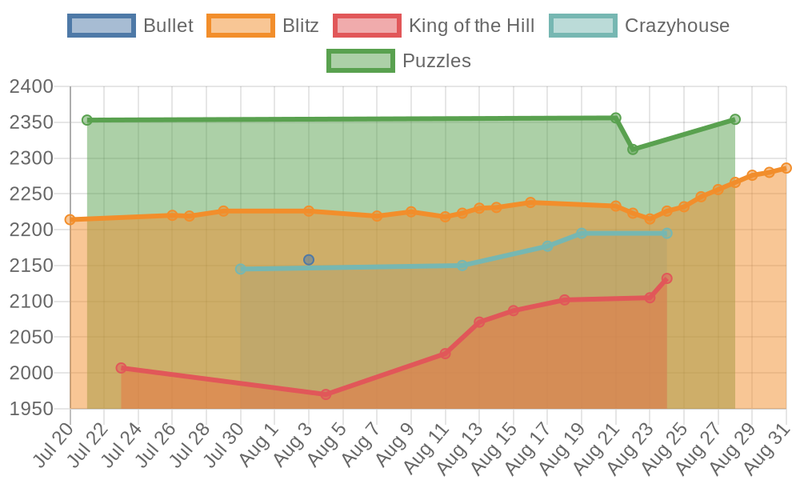
P.P.S. Here's what focus looks like in a real game:
You may also like
 Lichess
Accomplished Bangladeshi GM Ziaur Rahman Dies Mid-Game
Lichess extends its condolences to the family, friends, and many fans of GM Ziaur Rahman, who died a… Toadofsky
Hope Chess Is Better Than Hopeless Chess
"Only the player with the initiative has the right to attack." - Wilhelm Steinitz Toadofsky
Ratings Science is Hard
How do you eat an elephant? One bite at a time. Toadofsky
What is Creativity?
Are we creative at using technology, or do computers have a mind of their own? Lichess
Should I report this?
Ever encountered a user misbehaving on Lichess? Check out if and how to report them. GM NoelStuder