
Larry Kaufman
Lies, damned lies, and statistics
Statistics, while often used for accurate representation, can also be misused to distort the truth.
As always, opinions are my own, not those of Lichess.org.
A popular gamer "decided to drop out of the event to help maintain competitive integrity" shortly before Chess.com banned them for cheating. I'm actually impressed by this and subsequent half-apologies for accepting blame (even while continuing to conceal or distort the truth). However, their incidental comments sparked debate, such as:
Having the main stream open... led to me getting move information...
To commentators who even entertained this idea: you're telling me that a 600-rated player understands chess notation? Every explanation I've heard (even about a blunder "Nxd4") seemed to suggest reliance on notation. Sure, for the prize pool of that event I too might be motivated to learn notation (and it's not hard to learn); regardless, we're talking about a player who says, "So right here I had to make the choice to sacrifice the pawn..." etc. without mentioning any pieces, ranks, files or squares. A stronger player might say, "I played pawn-b4 so I could keep my knight in the center on d4 then with Bb2 focus an attack on g7 against their king and rook," or something like that.
(Stockfish doesn't have a UI: it just communicates in notation, as do viewers in a chat window. If Stockfish was used, some other software or web site was used too, unless the player was familiar with UCI protocol commands like "position startpos e2e4 e7e5 g1f3" and "go infinite" etc. But what casual amateur has ChessBase or SCID or similar installed?)
To earn a rating of 600, one needs to register an account then play some games. 600 is not the default rating, but rather is strong evidence of a rather limited understanding of the game. Since the average player may struggle with notation, absent dedicated effort I would expect such a player to heavily struggle reading notation. If I say "Bd3" and you're not imagining a light-squared bishop, perhaps you understand what I am saying.
What is curious, however, is that after the opponent played Nxd4 they played Nxd4?? blundering a queen. Popular consensus here is that this beginner was relying on notation from an engine, and got confused while trying to relay moves; but it is also possible for whatever reason they decided only sometimes to use external assistance (and maybe after losing their queen, they changed course). We'll never know (even if they tell us, they might not remember correctly or they may be lying). We have another confession:
Once I blundered my queen, I panicked. I used the analysis feature [on Lichess]...
however, as C-Squared notes, this fails to explain strong moves played earlier in the opening (rather than random pawn or queen moves).
Even C-Squared, who are timid in their assertions, may err in suggesting:
If a player plays Rb4, that's an immediate red flag...
I won't cite the entire quote here, and the particular tricky sequence (corralling the opponent's knight mid-board through fancy tactics) is suspicious, and sure, Rb4 could be something other than a mouseslip, but there are only a few moves in chess history which by themselves are actual red flags. Exhibit A: 23... Qg3! (Levitsky - Marshall, 1912):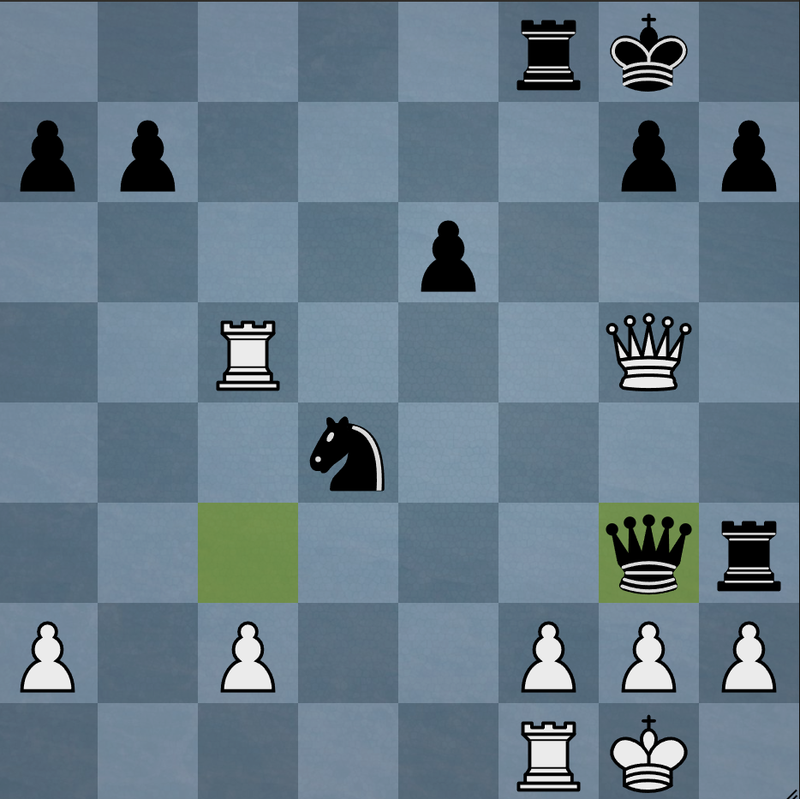
U.S. Champion Frank Marshall played this move decades before personal computers existed. Their previous move was 22... Rh3! setting up this mate. Perhaps inspired humans can play a single "engine move" (or in this case, two consecutive moves) after all... in which case, "red flag" can either mean:
- A personal note that something looks suspicious (what I think C-Squared claims)
- A public indication to other people that something is wrong (what I think Gotham and Chess.com employees tend to claim when suggesting that a player could be banned based upon one or more good moves, even without corroborating spyware/telemetry data)
Caruana points out that it is possible for a player to randomly play a perfect game, "Given that there may be 20 moves in any position, the odds of such a thing are less than one in a trillion." I concur: in some positions there are obvious checks or re-captures, and in other positions the best move may involve retreating a piece into a corner or a quiet move out of 30+ legal moves.
I am mildly curious: had the player used FICS or similar with a random opponent (with fixed colors), could they have won this event and perhaps even celebrated for having done so? This constant dithering about trying to imagine how an engine might play versus how a human might play seems so tiresome and unimaginative, as do Chess.com points about how necessary it is to install spyware on your machine to maintain integrity of the game.
Here's a more interesting question: why do players cheat? Thibault gives the only correct answer (as a non-cheater): "I don't know!"
https://youtu.be/LZgyVadkgmI?t=1152
(How best to discourage cheating is an even more interesting question. 1990's game Well of Souls allows cheating, but marks you as a cheater and otherwise lets you play the game. Various video games and 2018 PC game Celeste have built-in cheats/assists, but encourage you to try playing first without them. Some correspondence chess sites simply allow assistance, and if you cheat, the only player being cheated is yourself.)
Image credit: Larry Kaufman

You may also like
 Toadofsky
Ratings Science is Hard
How do you eat an elephant? One bite at a time. ebk1976
Aging in Chess
The age too old for gold. ChessMonitor_Stats
Where do Grandmasters play Chess? - Lichess vs. Chess.com
This is the first large-scale analysis of Grandmaster activity across Chess.com and Lichess from 200… Toadofsky
Hope Chess Is Better Than Hopeless Chess
"Only the player with the initiative has the right to attack." - Wilhelm Steinitz FM MathiCasa
Chess Football: A Fun and Creative Variant
Where chess pieces become "players" and the traditional chessboard turns into a soccer field CM HGabor