
Mary Moulton Cheney, Public domain, via Wikimedia Commons
Science of Chess: Thanks for a great 2025!
Just a brief post to say thanks to my readers and send best wishes for what 2026 may bring.
Well, dear readers, it's a few short hours (here in the Frozen North of the US) until we say goodbye to 2025 and greet the New Year. I intended to put together one more science-y post for you before year's end, but the holiday season is always a little busier than I think it's going to be. Thus, here I am at the cusp of the Old Year and the New Year without more Science of Chess to bring you, but wishing to say a word to my readership regardless. But first, a view of what the sun (and an optical phenomenon called sun dogs) look like on the last day of the year from Fargo, ND.
 Photo by the author.
I started seriously writing Science of Chess articles here about two years ago or so, and quite frankly didn't think anyone would pay them much mind. I was interested in finding out what there was in the cognitive science and neuroscience literature about the game and I wanted to work on writing for a broader audience than I usually do in my professional life. To my surprise and delight, it turns out a lot of you found those topics (and presumably my writing) interesting enough to keep reading. I'm wary of getting too distracted by analytics, but I looked back at 2025 and it seems like the Science of Chess got a little bit more than 100k views this year, which is WAY more than I would have imagined.
 I didn't even blog as much as I intended! This is the trouble with having a day job.
Besides the pieces I posted here, I was also fortunate enough to make contact with some more folks in the chess community who are excited about the science behind the game we all love. I was especially happy to be a guest on NM Ben Johnson's Perpetual Chess Podcastand hope that I can keep having good conversations with players much better than me about the cognitive aspects of the game I do understand pretty well.
Looking ahead to 2026, I have a bunch of projects in the works that I hope I can share with you soon. Some of these will be the usual Science of Chess posts you're used to, but I'm hoping to have some new directions to tell you about too. In particular, I'd like to spend more time writing about something I think about a lot - how DO you get better at chess? I've tried to steer away from making it sound like the Science of Chess is some gateway to CRUSHING your opponents, but there is a scientific literature about learning, memory, visual imagery, aging and other processes that affect how we play and how we improve. I think there's a lot of neat stuff in there that's probably relevant for us patzers who want to get better and also a lot of room to find out more about how learning chess may be different than learning other things.
 Promotional image from chess.com
For now, though, I want to close the year by saying thanks to all of you who have read, shared, and commented on the Science of Chess in 2025. There are lots of blogs out there, some written by GMs, IMs, CMs (and the occasional LLM) who play chess far better than I ever will. That so many of you have tuned in to read about the stuff I am an expert in means a lot and I'm very grateful for your attention.
So: Best wishes to all for a happy and healthy 2026! May your ELO only climb and your opponent always blunder more than you.
 Artemas Liu, CC BY-SA 2.0 <https://creativecommons.org/licenses/by-sa/2.0>, via Wikimedia Commons
Support Science of Chess posts!
Thanks as always for reading! If you're enjoying these Science of Chess posts and would like to send a small donation my way ($1-$5), you can visit my Ko-fi page here: https://ko-fi.com/bjbalas - Never expected, but always appreciated!
You may also like
 NDpatzer
Science of Chess: Seeing the board "holistically."
Better players may read a chessboard in the same ways we recognize faces. GM Avetik_ChessMood
10 Things to Give Up to Enjoy Chess Fully
Discover how embracing a lighter mindset can help you enjoy chess again and achieve better results. thibault
How I started building Lichess
I get this question sometimes. How did you decide to make a chess server? The truth is, I didn't. Lichess
Lichess: End of Year Update 2025
Is it just us, or has this year flown by? As we say goodbye to 2025 and enter 2026, let's look back …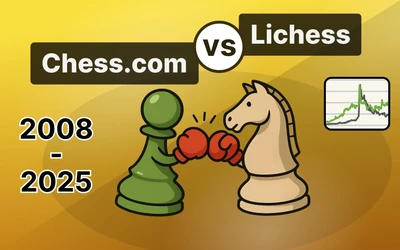 ChessMonitor_Stats
Where do Grandmasters play Chess? - Lichess vs. Chess.com
This is the first large-scale analysis of Grandmaster activity across Chess.com and Lichess from 200… NDpatzer